
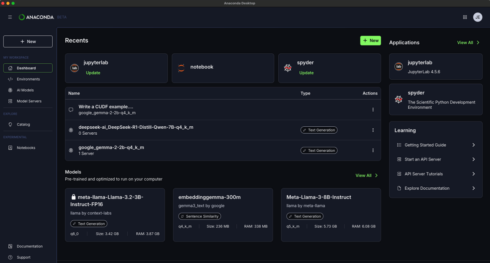
Anaconda, an infrastructure provider for the Python community for over a decade, has released into public beta Anaconda Desktop, a single application designed for AI development.
The application is built to unify the previously fractured workflow of managing large language models (LLMs) by bringing model discovery, local inference, and conda environment management together in one place. It serves as a centralized surface, replacing cobbled-together solutions often used for local AI stacks, which typically involved a separate model hub, an inference tool, and an API layer.
The tool is aimed at data science students, researchers, and engineers who previously relied on Anaconda Navigator to get their work off the ground.
The release addresses the modern complexity of data science and development, where LLMs have moved to the center of projects, forcing developers to manage servers and API layers alongside their package managers. Anaconda Desktop solves this by extending the functionality of the old Navigator to the full AI development workflow, aiming to accelerate developer velocity practically and securely. Everything built into Anaconda Navigator remains: creating and managing conda environments, installing packages, launching Jupyter Notebooks, and more. But now, local AI capabilities sit right alongside them.
The company also noted that new features are planned for later this summer, including the ability to deploy and manage multiple inference endpoints. The company also is working to expand Anaconda MCP to give AI agents direct, governed access to the conda ecosystem. Anaconda also noted that Navigator will be supported through the end of 2026 for existing users, but is urging users to move to Desktop.
The application is available for download on Windows, Mac, and Linux machines. It serves as a centralized surface, replacing “cobbled together solutions” often used for local AI stacks, which typically involved a separate model hub, an inference tool, and an API layer.