
GitLab has made its Duo Agent Platform generally available, providing development teams with agentic AI automation that has access to an organization’s full context, standards, and guardrails.
The GA release includes Agentic Chat, providing context-aware assistance throughout the GitLab platform. Agentic Chat builds on the previously released Duo Chat, and brings in context from issues, merge requests, pipelines, security findings, and more, and can perform actions on a developer’s behalf.
For example, in the Web UI, Agentic Chat can create issues, epics, merge requests, and highlight key findings and create actionable guidance based on organizational context. Additionally, in the IDE, it can generate code, configurations, and infrastructure-as-code, as well as fix bugs, generate texts, and produce documentation.
Other ways Agentic Chat can be used are helping developers understand, configure, or troubleshoot CI/CD pipelines or create new ones, and on the security front, it can explain vulnerabilities, help with issue prioritization, and recommend fixes.
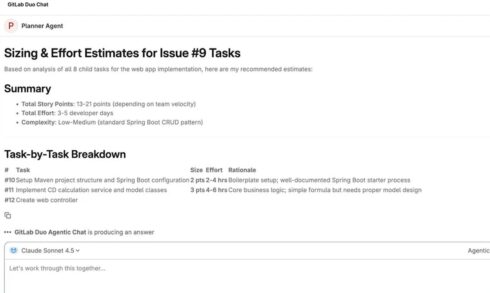
GitLab Duo Agent Platform also comes with pre-built foundational agents that are ready out of the box. Two are available at launch, and more are in beta and will be released later. The Planner Agent helps structure, prioritize, and break down work in GitLab, and the Security Analyst Agent reviews vulnerabilities and security signals and explains their impact.
Developers can also build custom agents to fit their own specific needs, or leverage external agents, such as Claude Code or OpenAI’s Codex CLI.
“Together, these approaches give teams flexibility in how they adopt agentic AI, from specialized agents, to organization-specific automation, to integrating external AI tools — all within a single, governed platform,” GitLab wrote in a post.
Foundational Agentic Flows are another important component of the platform, enabling multiple agents to be chained together to tackle complex tasks. Several flows are now available, including:
- Developer: Builds a merge request from an issue
- Convert to GitLab CI/CD: Helps migrate pipeline configuration
- Fix CI/CD pipelines: Analyzes failures, identifies likely causes, and prepares recommended changes
- Code Review: Streamlines code review by analyzing code changes, merge request comments, and more
- Software Development in IDE: Guides work through development and review stages
GitLab also offers an MCP Client to enable the platform to connect to other systems like Jira, Slack, Confluence, Playwright, and Grafana. Current features include configuration at the workspace and user level, group-level controls to enable or restrict usage, and a user approval flow for tool access.
Finally, the platform includes a number of features for governance and flexibility, including being available across all GitLab platforms in the 18.8 release cycle, model selection where subgroups inherit the choice of the top-level namespace, group-based access control to customize which users can access certain features, and LDAP and SAML integration.