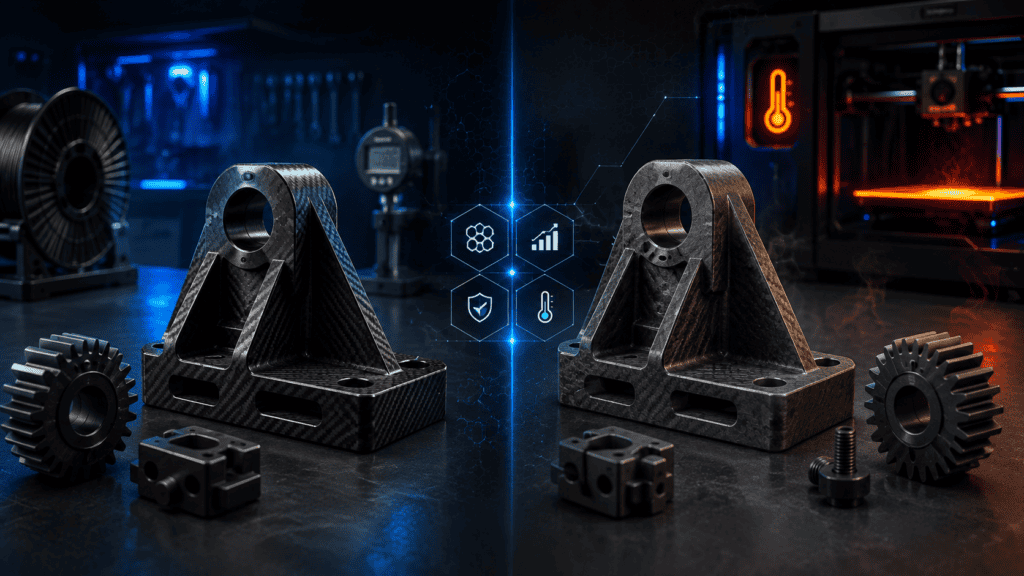
Quick answer: Choose PA-CF for strong, stiff engineering parts when your printer can reliably handle nylon composites. Move to PPA-CF when elevated-temperature performance and dimensional stability justify a more demanding process. PPA-CF is not simply “better nylon”; it belongs to a higher-performance polyamide class with correspondingly higher printer and drying requirements.
Why “nylon” is too broad a term
PA6, PA12, copolyamides and PPA are all polyamide-family materials, but they behave differently. Moisture absorption, stiffness, heat response and print temperature can vary substantially between grades.
That is why comparing “nylon CF” to “PPA CF” without looking at the exact polymer and data sheet can be misleading.
Why PA-CF is already a major upgrade
Carbon-fiber-filled PA is popular for functional brackets, robot components, jigs, fixtures and machine parts. The fibers increase stiffness and can improve dimensional stability compared with unfilled nylon.
For many advanced hobby and small-business applications, a good PA-CF already provides more performance than the part actually needs.
What PPA-CF is trying to improve
PPA — polyphthalamide — is used in applications where higher-temperature mechanical performance matters. PPA-CF grades target parts that need to stay stiff and dimensionally stable in conditions where mainstream nylons may soften or creep too much.
Process requirements
| PA-CF | PPA-CF | |
|---|---|---|
| Printer class | Advanced consumer / prosumer | High-temperature capable |
| Drying importance | Very high | Critical |
| Hardened nozzle | Yes | Yes |
| Enclosure | Often strongly recommended | Usually part of the expected setup |
| Use case | General engineering parts | Higher thermal / dimensional demand |
Drying is part of manufacturing, not storage housekeeping
Polyamides absorb moisture aggressively. A spool that “feels dry” can still contain enough water to cause bubbling, rough surfaces, weak extrusion and inconsistent properties.
For serious PA-CF/PPA-CF work, dry according to the manufacturer’s instructions and consider printing directly from a controlled dry box.
Printer temperature is only the beginning
A hotend capable of reaching the advertised nozzle temperature does not automatically make a printer suitable. Check:
- Hotend components and sustained temperature rating
- Build-surface compatibility
- Enclosure capability
- Extruder/nozzle abrasion resistance
- Whether the printer can maintain stable conditions on long jobs
Use the free Techmins Filament Selector to rank materials by heat, UV exposure, strength, flexibility and printer capability.
When PA-CF is the sensible choice
- Mechanical brackets and mounts
- Robot and machine components
- Strong jigs and fixtures
- Applications where PETG-CF/ASA are not enough, but extreme thermal performance is unnecessary
When PPA-CF earns its cost
- The part genuinely sees elevated service temperatures.
- Dimensional stability at heat is a primary requirement.
- Your printer is designed for the material.
- You can control drying and process conditions consistently.
Bottom line
Do not climb the material ladder for its own sake. A properly printed PA-CF is already a serious engineering solution. PPA-CF becomes valuable when the application exposes a real limitation of PA-CF — especially temperature and dimensional stability.