
Introduction
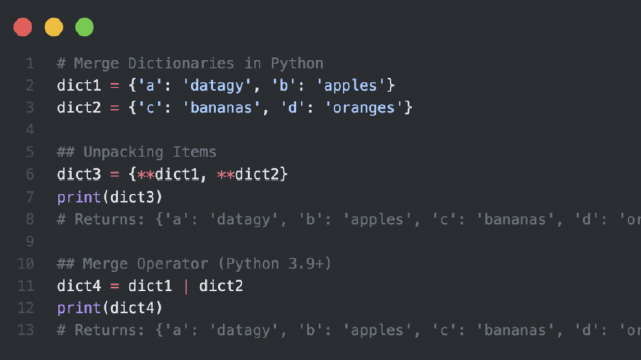
Dictionary merging is a common operation in Python that allows us to combine the contents of two dictionaries into a single dictionary. This process is helpful when we want to consolidate data from multiple sources or when we need to update the values of existing keys. This article will explore various methods for merging dictionaries, discuss common scenarios where merging is required, and provide best practices for handling key conflicts and preserving data integrity.
Methods for Merging Dictionaries
There are multiple methods available in Python for merging dictionaries. Let’s explore each of these methods in detail:
Using the update() Method
The update() method is a built-in method in Python dictionaries that allows us to merge the contents of one dictionary into another. This method takes another dictionary as an argument and updates the calling dictionary with the key-value pairs from the argument dictionary. If there are overlapping keys, the values from the argument dictionary will overwrite the values in the calling dictionary.
Code:
dict1 = {'a': 1, 'b': 2}

dict2 = {'b': 3, 'c': 4}

dict1.update(dict2)

print(dict1)
Output:
{‘a’: 1, ‘b’: 3, ‘c’: 4}
Using the ** Operator
In Python, the `**` operator can merge two dictionaries. This operator unpacks the key-value pairs from the second dictionary and adds them to the first dictionary. If there are any overlapping keys, the values from the second dictionary will overwrite the values in the first dictionary.
Code:
dict1 = {'a': 1, 'b': 2}

dict2 = {'b': 3, 'c': 4}

merged_dict = {**dict1, **dict2}

print(merged_dict)
Output:
{‘a’: 1, ‘b’: 3, ‘c’: 4}
Using the dict() Function
The dict() function can also merge dictionaries in Python. This function takes an iterable of key-value pairs as an argument and returns a new dictionary containing those pairs. By passing the key-value pairs from both dictionaries as arguments to the `dict()` function, we can merge the dictionaries.
Code:
dict1 = {'a': 1, 'b': 2}

dict2 = {'b': 3, 'c': 4}

merged_dict = dict(dict1, **dict2)

print(merged_dict)
Output:
{‘a’: 1, ‘b’: 3, ‘c’: 4}
Using the collections.ChainMap Class
The collections.ChainMap class in Python provides a way to merge dictionaries while preserving the original dictionaries. This class creates a single view of multiple dictionaries, allowing us to access and modify the merged dictionary as if it were a single dictionary.
Code:
from collections import ChainMap

dict1 = {'a': 1, 'b': 2}

dict2 = {'b': 3, 'c': 4}

merged_dict = ChainMap(dict1, dict2)

print(merged_dict)
Output:
ChainMap({‘a’: 1, ‘b’: 2}, {‘b’: 3, ‘c’: 4})
Common Scenarios for Merging Dictionaries
Merging dictionaries is a versatile operation that can be applied to various scenarios. Let’s explore some common scenarios where merging dictionaries is useful:
Merging Dictionaries with Overlapping Keys
When merging dictionaries, overlapping keys are expected. In such cases, the values from the second dictionary will overwrite the values from the first dictionary. This allows us to update the values of existing keys or add new ones and values to the merged dictionary.
Code:
dict1 = {'a': 1, 'b': 2}

dict2 = {'b': 3, 'c': 4}

merged_dict = {**dict1, **dict2}

print(merged_dict)
Output:
{‘a’: 1, ‘b’: 3, ‘c’: 4}
Merging Dictionaries with Different Data Types
Python dictionaries can contain values of different data types, such as strings, numbers, lists, or even other dictionaries. When merging dictionaries with different data types, the merged dictionary will contain the values from both dictionaries, preserving their original data types.
Code:
dict1 = {'a': 1, 'b': [2, 3]}

dict2 = {'b': (4, 5), 'c': 'hello'}

merged_dict = {**dict1, **dict2}

print(merged_dict)
Output:
{‘a’: 1, ‘b’: (4, 5), ‘c’: ‘hello’}
Best Practices for Merging Dictionaries
When merging dictionaries in Python, following some best practices to ensure data integrity and avoid potential issues is essential. Let’s discuss these best practices:
Handling Key Conflicts
When merging dictionaries, it is expected to encounter key conflicts where the same key exists. To handle critical conflicts, we must decide whether to overwrite the value from the first dictionary with the value from the second dictionary or keep both values. This decision depends on the specific requirements of our application.
Preserving Order in Merged Dictionaries
By default, dictionaries in Python do not preserve the order of key-value pairs. However, if order preservation is essential, we can use the collections.OrderedDict class or third-party libraries like ordereddict or sortedcontainers to create ordered dictionaries. This ensures that the order of key-value pairs is maintained during the merging process.
Avoiding Data Loss during Merging
When merging dictionaries, it is important to ensure no data is lost. To avoid data loss, we should carefully consider the merging method and handle key conflicts appropriately. Additionally, it is a good practice to create a backup of the original dictionaries before merging them in case we need to revert the changes.
Comparison of Dictionary Merging Techniques
Let’s compare the different techniques for merging dictionaries based on their performance, syntax, and use cases:
Performance Comparison
The performance of dictionary merging techniques can vary depending on the size of the dictionaries and the number of critical conflicts. The update() method and the `**` operator are generally faster than the dict() function and the collections.ChainMap class. However, the performance difference may not be significant for small dictionaries.
Syntax Comparison
The syntax for merging dictionaries using the update() method and the `**` operator is concise and straightforward. On the other hand, the syntax for merging dictionaries using the dict() function and the collections.ChainMap class is slightly more verbose. The choice of syntax depends on personal preference and the application’s specific requirements.
Use Case Comparison
The choice of dictionary merging technique depends on the specific use case. If we need to update the values of existing keys or add new keys and values to an existing dictionary, the update() method or the `**` operator are suitable choices. Suppose we want to preserve the original dictionaries and create a single view of multiple dictionaries, the collections.ChainMap class is a better option.
Conclusion
Merging dictionaries in Python is a powerful operation that allows us to combine data from multiple sources and update the values of existing keys. This article explored various methods for merging dictionaries, discussed common scenarios where merging is required, and provided best practices for handling key conflicts and preserving data integrity. By understanding the different techniques and their trade-offs, we can easily merge dictionaries in Python and manipulate data.