
Discover the best Tiny Whoops on the market, these small FPV drones are perfect for indoor FPV flying and racing. In this article, we will provide a comprehensive list of the top Tiny Whoops available, detailing their specs, pros, and cons to help you make an informed decision.

What’s a Tiny Whoop?
A Tiny Whoop is a small indoor FPV drone featuring 31-40mm propellers, protective propeller guards (also known as ducts), and 65mm or 75mm frame wheelbases. They usually operate on 1S or 2S LiPo batteries. Tiny Whoop is a trademark by a US-based company that popularized this type of micro drones, so people in the hobby simply call all these small drones “Tiny Whoops”. These affordable, easy-to-control FPV drones are perfect for indoor flying and can also be flown outdoors in wind-protected areas. Their ducts ensure safety and reduce damage upon crashes.
Best 65mm Tiny Whoops
These 65mm Tiny Whoops are small, relatively quiet, and easy to control, making them the best whoops for indoor flying. A few bind and fly models stand out due to their superior performance, durability and value.
NewBeeDrone Acrobee65 BLV4

The AcroBee65 BLV4 from NewBeeDrone is a feature-rich tiny whoop FPV drone for newcomers. One of the significant advantages of this model comes from the company itself. NewBeeDrone, based in California, is known for its outstanding customer support which is essential for beginners.
It offers upgrades like ExpressLRS, BlueJay ESC, and a more durable frame. However, it has drawbacks, such as heavier weight and an outdated PH2.0 battery connector. See this post for more detail about this drone: https://oscarliang.com/newbeedrone-acrobee65-blv4-tiny-whoop/
On paper, it might be a little hard to justify choosing the Acrobee over the Mobula6 considering various factors such as price and weight (which impacts flight performance). The Acrobee’s strongest suit lies in the support you get from the company. With NewBeeDrone, you’re not just buying a product, but also their dedicated customer service.
Get the Acrobee65 BL4 from:
NBD: https://oscarliang.com/product-qc15
RDQ: https://oscarliang.com/product-snww
Best 75mm Tiny Whoops
If you are looking for a more powerful whoop, or perhaps something that can even fly outdoor, 75mm whoops are a better choice than 65mm. There are also more options when it comes to HD Digital FPV systems.
BetaFPV Meteor75 Pro

The BetaFPV Meteor75 Pro is a 1S Tiny Whoop that is available in various FPV systems: analog, Walksnail Avatar and HDZero, delivering a game-changing HD video feed. It has integrated ExpressLRS, providing excellent range. It’s using slightly larger propellers, which gives them extra power and stability for flying outdoor. However, the Meteor75 is heavier than the Mobula7 due to the larger size, impacting its agility especially when flying indoor.
Despite this, the Meteor75 still offers a smooth, enjoyable flying experience, and the stock PID tune is decent. Personally I recommend the analog version, because HDZero and Walksnail VTX’s just don’t work well with 1S (they shut down prematurely when voltage drops below 3.3V), but the HD video provided by Walksnail VTX is impressive nonetheless, providing clearer, more immersive visuals. Also note that the analog version is significantly lighter and so it also flies much better too. If you are looking for a 1S tiny whoop for flying outdoor, this is worth considering.
Analog Version
BetaFPV: https://oscarliang.com/product-l5z4
Amazon: https://amzn.to/3BwAQS0
AliExpress: https://s.click.aliexpress.com/e/_DdvPnnx
RDQ: https://oscarliang.com/product-ghtu
HD Version
BetaFPV: https://oscarliang.com/product-r2la
RDQ: https://oscarliang.com/product-nghw
Amazon: https://amzn.to/42J9jbL
AliExpress: https://s.click.aliexpress.com/e/_DlLKttR
Wheelbase: 65mm vs 75mm

Right: 65mm tiny whoop, Middle: 75mm tiny whoop
Wheelbase refers to the size of the frame, which is the distance between two diagonal motors. For tiny whoops typically comes in two wheelbase sizes: 65mm and 75mm.
The 65mm whoops are the classic, they are more agile and easier to control, and the more popular choice for flying at home since they are also slightly smaller. On the other hand, the 75mm whoops offer greater power due to their larger propeller and batteries. Some might find them harder to control than the 65mm but they are more versatile and faster.
If you’re undecided between 65mm and 75mm whoops, 75mm generally offers longer flight times, faster speeds, and better stability for outdoor flying. However, 65mm whoops are more agile and can navigate smaller gaps. Some racing events only permit 65mm whoops, so take this into account if you’re serious about racing.
Brushed Motors or Brushless Motors

Tiny Whoops utilize two types of motors: brushed and Brushless. In summary:
- Brushless whoop: more powerful, better motor longevity, supports turtle mode, 48kHz, and RPM filter
- Brushed whoop: cheaper, simple, and lightweight
Previously, the decision between motor types for a tiny whoop was more challenging. However, with the introduction of performance features such as RPM filter and 48kHz support in BLHeli_S, brushless motors have become the standard while brushed whoops have become obsolete.
Battery Cell Count: 1S vs 2S

Learn about LiPo cell count in this tutorial: https://oscarliang.com/lipo-battery-guide/#cell-count
Tiny Whoops typically operate on 1S or 2S battery packs, with 1S signifying one cell and 2S representing two cells. Typically, the higher the cell count, the more powerful the drone.
1S whoops are lighter, quieter, safer, and cause less damage during crashes, making them ideal for casual indoor FPV flying. On the other hand, 2S whoops are more powerful and more suited for outdoor flight in calm weather or for lifting heavier payloads, such as better cameras or FPV systems. However, they might be harder to fly indoor in tighter spaces.
LiPo Battery Connectors
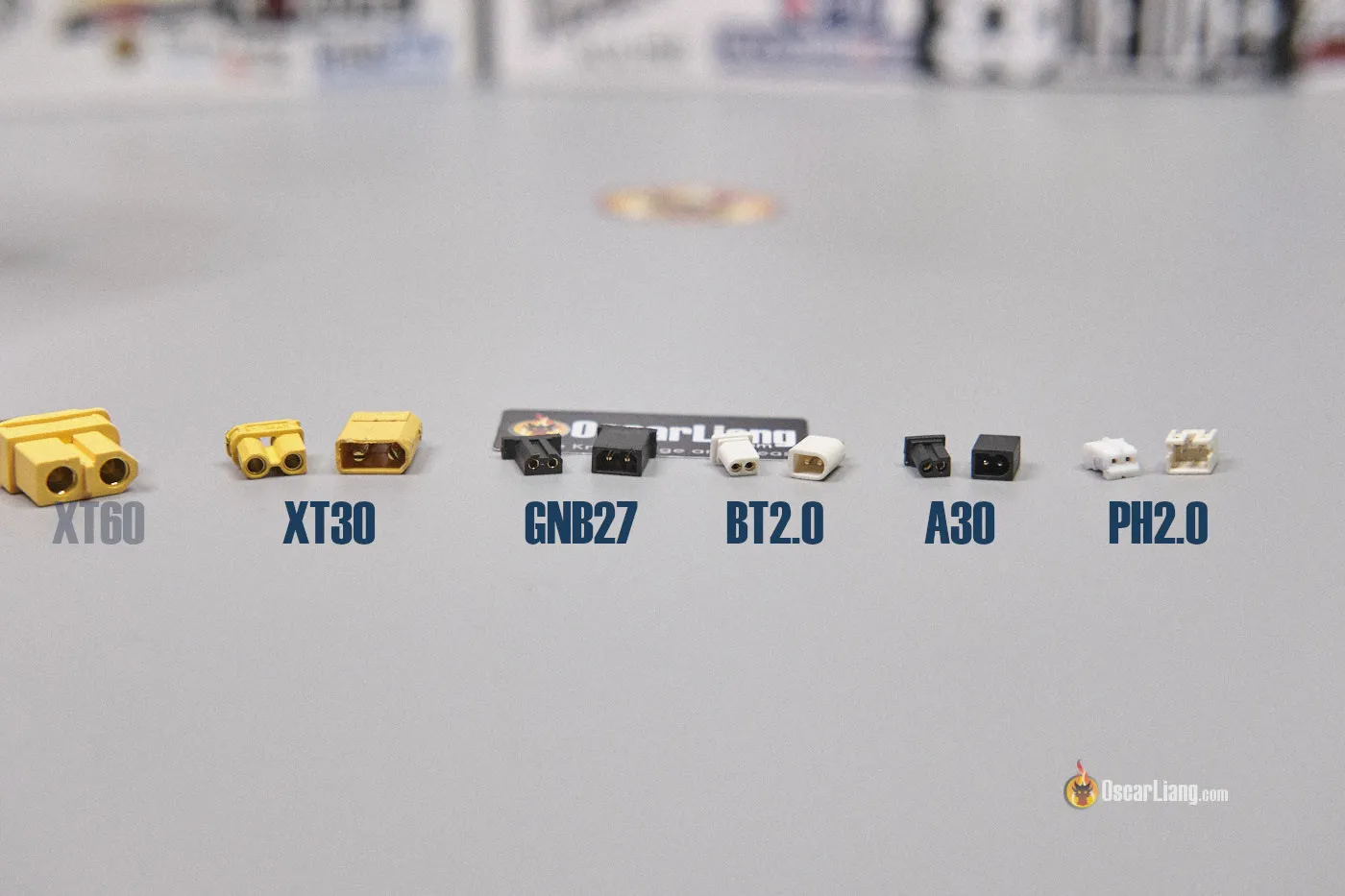
As tested, BT2.0 and A30 connectors are the ideal choices for tiny whoops by providing stronger power and slightly longer flight times. This is due to their lower resistance and less voltage drop under load. While PH2.0 connectors are functional and adequate for everyday flying, you should use BT2.0 or A30 whenever you can and avoid PH2.0.
If your whoop have a PH2.0 connector, you can easily replace it with a BT2.0 connector if you know how to solder. Avoid using a PH2.0 to BT2.0 adapter, as it introduces additional resistance and negates the benefits of the superior BT2.0 connector.
It’s essential to choose a connector type before bulk purchasing LiPo batteries to ensure they have matching connectors.
Essential Accessories and Parts
Here are some useful accessories and parts for tiny whoops.
Battery Considerations
Voltage: LiHV vs LiPo
Most tiny whoops use LiHV batteries for higher power and capacity at a lower weight, while also being compatible with LiPo batteries. LiHV batteries offers superior performance for micro drones as tested here, and that should be your default option.
Connectors: BT2.0 vs A30 vs PH2.0
Batteries connect to your tiny whoop via a connector. The majority of tiny whoops have a PH2.0 connector, so ensure the batteries you purchase are compatible. Watch out for battery connector, A30/BT2.0 are not compatible with PH2.0.
Note that you can use A30 batteries with BT2.0 connectors on the quad, You might be able to use BT2.0 batteries with A30, but you have to plug it in forcefully which might damage the plastic over time.
Cell Types
If you’re focused on performance, consider opting for ‘folded/square cells’, which outperform traditional ‘rolled/rounded cells’. Folded cells are more efficient and exhibit less voltage sag. As of this writing, to the best of my knowledge, Tattu is the only manufacturer producing folded cells (their 1S 300mAh and 450mAh HV lineup) in 2023, but that could change in the future. Other companies, like WeBleedFPV and TinyWhoop, rebrand their batteries using the same cells. The rest on the market are primarily rolled cells.
Rolled cells deliver decent performance, especially when paired with a quality connector like the BT2.0. However, for the best possible performance, squared cells are preferable.
So why aren’t folded cells used in larger batteries? Beyond a certain capacity threshold, such as 500mAh, the cell size is sufficient for traditional cell types to perform comparably to folded cells. Folded cells are particularly advantageous in compensating for the limitations of very small sizes, like 300mAh and 450mAh.
Performance
If you are looking for flight time at relatively slow speed, you should get a battery with high capacity to weight ratio. However for most of us who fly tiny whoops, we constantly doing acro moves and tricks, power and voltage sags are more important considerations.
Best A30 & BT2.0 Batteries
Best PH2.0 Batteries
2S LiPo Batteries for 75mm Whoops
Best Tiny Whoop Chargers
Vifly WhoopStor V3

The Vifly WhoopStor V3 is arguably one of the most feature-packed 1S LiPo chargers available today. It accommodates all popular BT2.0, A30 and PH2.0 batteries and can independently charge up to 6 batteries simultaneously. The charger also supports discharging and storage-charging batteries, offering an impressive charging current of up to 1.3A per port. For a detailed review of the WhoopStor V3 charger, visit: https://oscarliang.com/vifly-whoopstor-v3/
Find the Vifly WhoopStor V3 from these vendors:
AliExpress: https://s.click.aliexpress.com/e/_DeZwHol
RDQ: https://oscarliang.com/product-4ies
BetaFPV BT2.0 Charger V2

A charger that doubles as a voltage tester, designed for batteries with BT2.0 connectors only. It gets power through the USB-C input connector, and is capable of charging two packs simultaneously to 4.35V, meaning it’s only compatible with LiHV packs. Not suitable for normal LiPo packs that require 4.20V charging.
Product Pages:
BetaFPV: https://oscarliang.com/product-j3s4
GetFPV: https://oscarliang.com/product-nxly
NewBeeDrone Nectar Injector Smart Charger

This charger can charge up to 4 batteries with PH2.0 connectors at once, with adjustable end voltage for each side of two ports. The benefits of this charger is the ability to monitor each battery being charged and constantly adjust charge current according the charging state. It has a trickle charge mode for over-discharged batteries (a unique feature in 1S Lipo charger) and is powered by a 5V micro USB input.
Product Pages:
NewBeeDrone: https://oscarliang.com/product-7b28
GetFPV: https://oscarliang.com/product-c7b8
ViFly Whoop Serial Charging Board

It’s not a charger, but a charging board. It basically connects all your batteries in series as a single battery. Unlike parallel charging, with series charging, even if the batteries have very different voltage you can still connect them to the board, the charger will balance the voltage during charging. All batteries must be of the same type (LiHV or LiPo). You can learn more about series charging in this tutorial: https://oscarliang.com/serial-charging/
31mm Propellers for 65mm Whoops
Although most 31mm props are for motors with 1mm shaft, it’s best if you confirm before ordering, sometimes motors could have 1.5mm shafts.
Gemfan 1208 Triblade 1mm Shaft

The Gemfan 1208-3 31mm Tri-Blade propellers offer an impressive combination of light weight and increased grip, making them a favorite choice among racers. With a low pitch design, these propellers pair well with high KV motors, providing excellent flight time and response. The properly sized and open-topped mounting hole ensures hassle-free installation and removal, making these tri-blade props a reliable option for pilots.
AliExpress: https://s.click.aliexpress.com/e/_DkTm3EV
40mm Propellers for 75mm Whoops
This is some of the best performing props on the market with a great balance between power and efficiency. Make sure to select the right shaft diameter to match the motors.
Motors
It’s a trend in tiny whoop motors to use higher KV with tri-blade propellers, such as 25000KV and 26000KV, as they give you more power. In a nutshell, higher KV means the motor will spin faster when apply the same voltage. See this post for a more detailed explanation: https://oscarliang.com/motors/#KV
For bi-blade propellers you need high RPM to unleash the desire power, typically pairing them with motors in the 28,000 to 32,000 KV range gives great result.
While experienced pilots can undoubtedly harness the full potential of high KV motors, beginners and intermediate flyers might find them too aggressive. Instead of using low KV motors, I’d recommend starting with a minimum of 26,000 KV motors and then cap the throttle or motor outputs to tame the power if necessary (you can do this either in the radio or Betaflight settings). With this method, even less experienced pilots can gradually build up their skills to flying higher KV motors while having the flexibility to control their power.
For 65mm whoops, 0702 is a popular motor size, choose between 26000KV and 30000KV depends on your propeller choice. For 75mm whoops, 1002 is a great motor size. For heavier builds with digital VTX’s, consider even bigger 1102 motors.
1002 is great for analog whoops, and
Flywoo Robo 1002
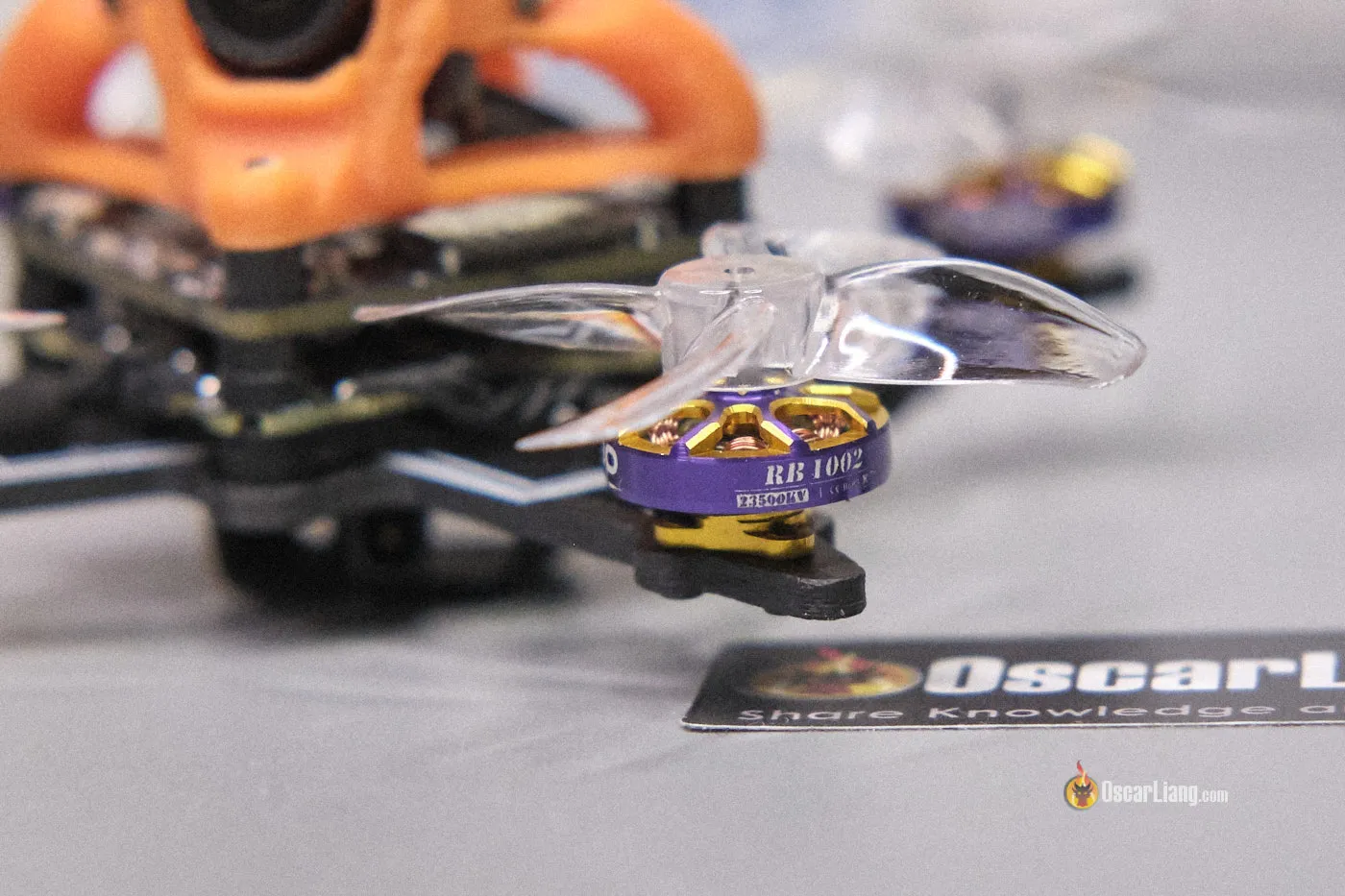
If you’re looking to build a 75mm Tiny Whoop, these 1002 motors are a standout choice. These motors offer an impressive ability to control larger 1.6-inch (40mm) propellers. When paired with Gemfan bi-blade or tri-blade propellers and a 450mAh square-cell battery, these motors perform incredibly well.
AliExpress: https://s.click.aliexpress.com/e/_DdQVR6J
Flywoo: https://oscarliang.com/product-d37w
Flight Controllers
VTX Antenna
TrueRC Singularity 5.8GHz Antenna with Short U.FL
Most BNF Tiny Whoops come with a simple whip antenna (linear polarized dipole antenna). They are ok, but upgrading to the TrueRC Singularity Antenna offers noticeable performance improvement while only adding half a gram of extra weight. If you are struggling with video signal when flying indoor, you should consider upgrading to a circular polarized antenna. I explained why circular polarized antenna are better for FPV than linear polarized antennas here.
Product pages:
Spare 65mm Whoop Frames
Both options listed here are some of the most durable frames available. They also come with many colour options. You can’t go wrong with either one.
BetaFPV Meteor65 Frame
NewBeeDrone V2 Cockroach Frame
ExpressLRS Receivers

Left: ceramic antenna; Right: flat antenna
ExpressLRS has emerged as the best radio control link for Tiny Whoops for numerous reasons. Firstly, it’s open-source, making it readily available and adaptable. This feature has made it easy for manufacturers to incorporate it into their flight controllers.
Furthermore, ExpressLRS offers excellent range and penetration, outperforming many competitors in the market (such as Frsky D8/D16). Also telemetry is fully supported in ExpressLRS. Admittedly, it can be somewhat tricky to set up initially for some users, but once mastered, its performance and versatility make it worth the learning curve.
Many new tiny whoop flight controllers offer built-in ELRS receiver, but if not you can also hook up an external ELRS receiver if there’s a spare UART. The RX is very lightweight, and the antenna is compact and doesn’t require mounting. Make sure to get the ones with ceramic antenna (or flat antenna) for space saving.
For an updated list of receiver available, check this list: https://oscarliang.com/setup-expresslrs-2-4ghz/#Receivers
Using Throttle Expo for Indoor Flights
To make your drone easier to control when flying indoor, consider using some throttle expo.
Throttle Expo refers to exponential throttle curve adjustments, allowing more precise throttle control in tight spaces, especially when most whoops come with powerful high-KV motors these days.
With high-KV motors, there’s a tendency to lose significant throttle resolution, which can make precise control challenging. But when flying indoors, you’re usually hovering or cruising around 30-35% throttle. Applying 20-30 throttle expo around this throttle value can make control more precise and easier.
Learn more about Throttle Expo here: https://oscarliang.com/throttle-curve/#Adjusting-Throttle-Curve-in-Betaflight
What’s the Best DJI O3 Tiny Whoop?
First and foremost, the DJI O3 Air Unit, while a marvel in FPV technology, introduces significant weight constraints. This is particularly problematic for drones designed to excel in tight indoor spaces.
While there are pilots showcasing their skill with 85mm whoops in cramped quarters, such feats are more the exception than the rule. For the majority, a 65 or 75mm whoop provides the agility and safety needed for indoor flying. However, by the time we scale up to an 85mm drone, the added speed and weight will cause more damage when you crash.
If you insist on flying an DJI O3 drone indoor, I would consider one of the 75mm whoops, such as the BetaFPV Pavo Pico or Flywoo Flylens 75. But I found even these drones are a bit too heavy for flying indoor safely and comfortably.
Walksnail offers light weight 1S VTX that is way more suitable for indoor light weight tiny whoops, but they suffer from premature shutdown when voltage drops below 3.3V which might not be ideal for some people.
Edit History
- 2018 – Post created
- 2019 – Updated product recommendations
- 2020 – Updated product recommendations
- 2021 – Updated product recommendations
- 2022 – Updated products, added tiny whoop accessories and parts
- 2023 – Updated products
- May 2024 – Updated