
In today’s highly digitalized and interconnected world, any business can find the best remote software development teams at the most attractive prices to build their own business apps.
However, the searching process of these teams can turn into a real challenge. The IT market is highly competitive. And every software outsourcing vendor proudly represents its achievements and great developer skills on its site.
All that can be quite perplexing, especially for a novice who looks for a decent software development company for the first time.
How to avoid confusion and choose the right outsourcing partner? In this article, we look into the software vendor selection process in IT outsourcing services and share practical tips on how to opt for the best one.
Why Companies Outsource Software Development
Software outsourcing long ago transformed from a cost-cutting tactic only into a strategic growth decision. Today, companies outsource development for a wide spectrum of reasons.
Access to Specialized Engineering Talent
One of the primary reasons companies outsource software development is to access specialized technical expertise that may be difficult to hire internally.
Modern software projects often require advanced capabilities in areas such as artificial intelligence, cloud computing, DevOps, cybersecurity, mobile development, and enterprise integrations. Building an in-house team with all these competencies can be expensive and time-consuming, especially in highly competitive hiring markets.
Faster Time-to-Market
In highly dense industries, speed can determine whether a product succeeds or falls behind competitors. Companies outsource software development to accelerate delivery timelines and reduce the delays associated with traditional hiring processes.
Instead of assembling internal teams from scratch, organizations can quickly engage vendors with established development teams and mature delivery practices.
24/7 Development and Global Collaboration Advantages
Global outsourcing models can create opportunities for near-continuous development cycles across multiple time zones. When teams are distributed internationally, development, testing, maintenance, and support activities can continue around the clock, accelerating delivery schedules.
Outsourcing Models Explained
Choosing the right outsourcing model is one of the most important decisions in the software outsourcing process. Different models offer varying levels of control and cost plans, depending on a company’s goals, project complexity, and internal technical capabilities.

Onshore Outsourcing
Onshore outsourcing implies partnering with a software development company located within the same country as the client organization. This model is often chosen by businesses that prefer clear communication because both teams operate within the same legal, linguistic, and business space. This way, project coordination tends to be more predictable.
However, the convenience offered by onshore outsourcing usually comes with higher development costs compared to offshore or nearshore alternatives. Labor expenses in local markets can significantly increase project budgets, especially in countries with competitive technology sectors.
Offshore Outsourcing
Offshore outsourcing refers to working with software development teams located in distant countries, often in regions with lower operational and labor costs. This model has become one of the most widely adopted outsourcing approaches because it allows businesses to significantly reduce development expenses.
Nonetheless, offshore outsourcing can introduce operational challenges if not managed effectively. Significant timezone differences may slow communication, while language barriers and cultural differences can affect collaboration and project alignment.
Nearshore Outsourcing
Nearshore outsourcing involves partnering with software development teams located in nearby or neighboring countries that operate within similar or overlapping time zones. This model has gained popularity because it combines many of the cost advantages of offshore outsourcing with the collaboration benefits typically associated with onshore partnerships.
One of the biggest strengths of nearshore outsourcing is real-time communication. Teams can collaborate during shared business hours, making Agile ceremonies, sprint planning sessions, and day-to-day coordination significantly more efficient.
Key Ideas to Keep in Mind When Choosing the Right IT Service Provider
Before selecting any outsourcing company, businesses should take their time and turn their attention to their projects. They have to realize clearly the type of their project, what the requirements of their product are, and decide on an engagement model.
Project Evaluation
To understand their projects better, businesses can take the following steps:
- Define the type of a project: If it’s an MVP or a simple project with minimum features to implement, or a complex solution with flexible requirements.
- Evaluate the scope of a project: Customers need to decide on details that they already know about their future product, define the questions they need to discuss with their future vendor, consider the staff and equipment they need for successful app development, and others.
- Estimate the project budget: Budgets for small projects with detailed requirements are easy to calculate, while the budgets for large ones with changing requirements can be reevaluated several times along the project.
- Define time to market: Customers should realize if an early app release is a determining factor for the success of their business, or if they could afford more time for their app development.
- Establish deadlines: Customers have to define the deadlines that can’t be postponed or moved, and are extremely important for the project’s success.
- Choose a software process model: There is a wide range of software process models in IT, including waterfall, Incremental, Agile, RAD, and many others.
Each of them defines the working style of a project team and the activities undertaken during the development process. The selection criteria for software process models strongly depend on the project’s scope, requirements flexibility, and type of system to be developed.
Choosing the Right Engagement Model
Once a company has evaluated its project, the next step it should take is to decide which engagement model suits its project best. This will help them to define customer-vendor working regulations, including terms of cooperation, project deadlines, pricing policy, and other regulations.
Here are the most widespread engagement models in IT outsourcing.
- Fixed-Price Model: A fixed price model is a classic approach in software development services. This type of service implies that a customer decides on the product requirements in advance, and they can’t be changed later on. The fixed price model works great for small projects when the budget is limited, and the features and requirements are clear.
- Time & Materials Contract (T&M): The T&M model is based on the idea of gradual spending of project resources on product development. It means that customers decide which features to spend their time and money on and which changes to implement so that their apps meet most of the end-users’ requirements. This engagement model suits well for long-term and complex development projects when product requirements aren’t clear. The costs are based on an hourly rate and discussed with the software outsourcing agency in advance.
- Dedicated Team Model (ODT): A dedicated team engagement model is about hiring a software development team that performs a full circle of product development. These teams usually include frontend and backend developers, QA engineers, designers, project managers, and any other specialists a customer might need for successful app development. Customers get a fully-equipped software development team that can fulfill projects of any complexity and duration. Moreover, they can scale up or down their teams depending on the project needs.
- Outstaffing: The outstaffing engagement model involves hiring particular specialists from a software development company to integrate them into a customer’s in-house developer team. It means that a hired employee works remotely full-time, adjusting to the policies and schedules of an in-house team. Outstaffing is ideal for staff augmentation, when customers need to enhance their team’s working capacity, hire seasonal workers, or substitute temporarily absent employees.
Here is a quick engagement model comparison you can quickly refer to when making your choice:
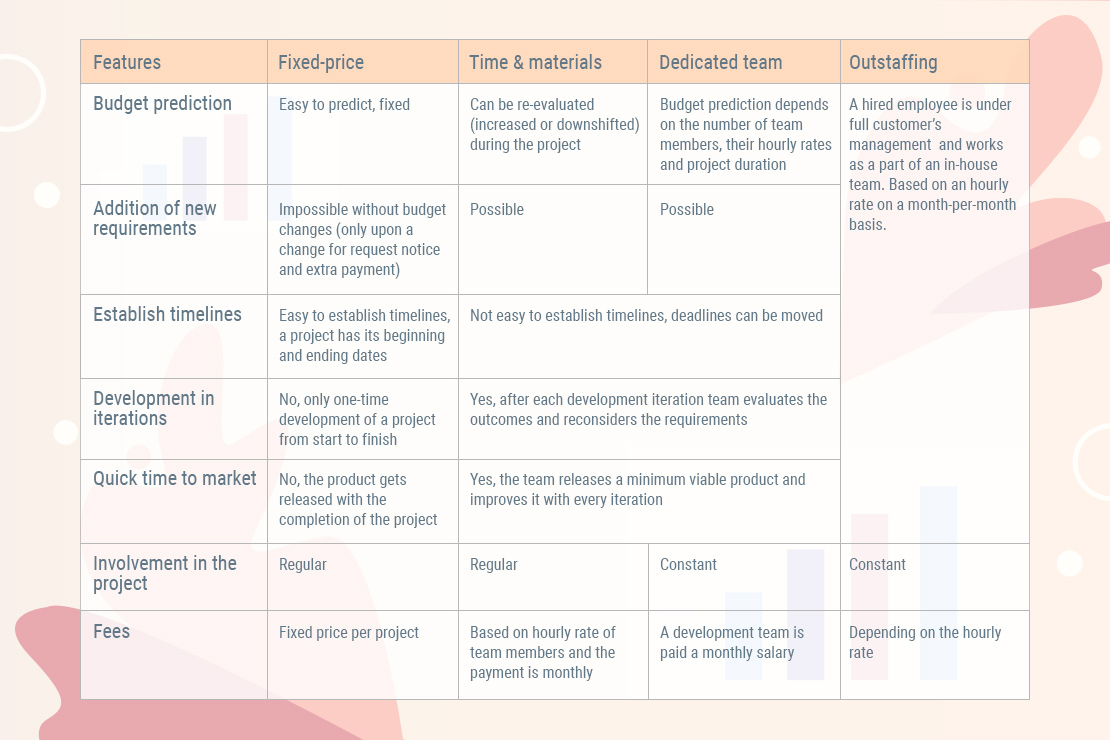
Comparison of Software Outsourcing Engagement Models
Main Vendor Selection Criteria to Base Your Evaluation On
As a business has evaluated its project and decided on which engagement model to use, it’s time to find a suitable vendor. Vendor selection criteria are often based on IT provider relevant experience, portfolio, reviews, and some other factors. Here is a list of essential criteria for software vendor evaluation.
Experience
There is a wide range of software development vendors with different levels of software development experience and expertise. To find the right one, businesses need to search for those who have hands-on experience in projects similar to theirs.
For example, if a company specializes in IoT, it’s very likely that its teams also develop various logistics tracking software or enterprise apps that involve IoT solutions.
Businesses can search for agencies with relevant experience on specialized tech sites like Clutch, Glassdoor, Upwork, and others, or on social media like Facebook and LinkedIn.
Expertise
It may be quite challenging for some companies to find tech experts locally. For example, they may need developers with a special technology stack, like blockchain development, working with artificial intelligence and Big Data, or building microservices-based apps in Java. That’s why many businesses search for them abroad.
Those businesses that look for a certain skill set outside their countries should aim at the IT companies that have the necessary expertise. For this, they need to:
- Create a shortlist of the vendors specialized in the areas of their interest
- Prepare a set of questions for the specialists and hold face-to-face interviews with them
Another point to consider is tech infrastructure. Software vendors should provide their customers with great hardware and software infrastructure, as well as networks. This will ensure that the delivered apps are thoroughly built, well tested, and that the data is securely stored and exchanged.
Portfolio and References
Shortlists help businesses to narrow down the number of software outsourcing companies. Once business managers create a list of their potential candidates, they have to make it even shorter. For this, they can conduct deep research on the chosen companies. One of the effective ways to do so is to investigate vendors’ portfolio and references.
Business managers can go to the companies’ websites and evaluate:
- How well they are organized and developed
- What projects they have in their portfolios
- What kind of prior working experience they have
Besides that, business managers can visit social media sites and specialized sites like Clutch and search for companies’ reviews.
Location and Communication
For companies looking for remote software vendors, it’s still important that they have the possibility to visit their software development partners.
This will help businesses to better establish relationships with their IT outsourcing service provider and better communicate their project ideas. Therefore, businesses can search for vendors within a 2-5 hour flying distance, like Eastern European providers for the EU.
However, if visiting a software outsourcing vendor’s location isn’t an option, businesses need to make sure that their communication channels are well-established. It means that software development companies provide them with:
- Means of instant communication, like Teams, Slack messengers, and corporate emails
- Software for project development and work progress tracking apps, like Basecamp and Jira
- Apps for video conferencing, like Zoom and Teams, and a schedule for planned meetings
Besides the means of communication, businesses need to make sure that the software development team has a strong level of English language expertise and can readily answer all the customers’ queries.
Pricing
Pricing is the factor that many businesses check first when selecting their vendor. Though pricing is important, businesses shouldn’t base their choices only on it. The cheapest rates can lead to higher expenditures in the long run.
Low prices are often provided by inexperienced companies. This results in longer product delivery, poor testing and security, higher rates of bugs, and unprofessionally developed apps. On the other hand, too high rates don’t necessarily signify quality. Therefore, the best option is to choose the software development companies in the medium-price segment.
Besides the overall software development companies’ rates, businesses should consider the type of work needed to develop their apps.
For example, there is no need to hire full-time graphic designers if they don’t participate in all the stages of a project. In this case, it’s better to consider hourly rates. And if a company wants to run long-projects then the best option would be hiring a dedicated development team.
How to Evaluate Software Development Outsourcing Vendors
Choosing a provider requires more than comparing pricing sheets or reviewing polished marketing materials. Many providers present impressive portfolios and broad technical claims, but successful outsourcing partnerships depend on factors that are often less visible during the initial sales process.

Analyze Real Project Experience, Not Just Portfolio Highlights
Most outsourcing companies showcase successful projects, recognizable client logos, and polished case studies. Although these materials can provide useful context, they rarely reveal how the provider performs during difficult phases of a project.
Instead of focusing only on visual outcomes or high-level success claims, companies should evaluate the operational side of past engagements. Some extra areas to explore include:
- The size and structure of the delivery team
- The vendor’s specific responsibilities within the project
- Technologies and infrastructure involved
- Project duration and delivery methodology
- Major technical or operational obstacles encountered
- How scope changes or shifting priorities were managed
- Business results achieved after launch
Speak With Clients Who Worked Through Challenges
Reference conversations become significantly more valuable when they focus on how the outsourcing firm managed problems rather than simply confirming overall satisfaction. Most outsourcing projects encounter changing requirements, unexpected delays, technical blockers, or miscommunication at some stage.
The key question is not whether problems occurred, but how the provider responded when they did.
Instead of relying on generic testimonials, companies should ask previous clients about communication during high-pressure situations, team stability throughout the engagement, problem-solving and accountability, and overall collaboration experience.
Honest client feedback often reveals operational strengths and weaknesses that are difficult to identify during formal sales presentations.
Identify Warning Signs Before Engagement Begins
Certain behavioral patterns during the assessment phase may signal future risks. Companies should pay close attention to inconsistencies, vague phrasing, or unrealistic commitments that emerge during the early stages of the process. Common red flags include:
- Extremely low pricing compared to comparable providers
- Overly aggressive delivery timelines
- Generic proposals lacking technical depth
- Slow communication
- Difficulty arranging access to technical team members
- Reluctance to discuss previous project challenges
In many cases, problems visible during selection become more severe once development work begins. Careful due diligence helps organizations avoid costly partnership failures later.
How to Manage a Software Outsourcing Partnership
Managing a partnership depends on creating structure, alignment, and clear collaboration between internal and external development teams. The goal is to operate as a single unit rather than separate entities, with shared responsibility for outcomes rather than just task execution.
Start with communication. Agree on how you’ll stay in touch, how often you’ll meet, and who the main points of contact are. Don’t rely on random updates, set a steady rhythm with weekly check-ins and regular progress reviews so nothing slips through the cracks.
Next, be very clear about roles. Decide who owns product decisions, who handles technical direction, who manages tasks, and who is responsible for quality. When ownership is unclear, work slows down and decisions get delayed.
Also, carefully handle changes. In software projects, requirements will shift, but don’t treat every new idea as automatic scope. Always check what the change means for timeline, cost, and effort before agreeing to it.
Stay involved in the product, not just the tasks. The more context the external team has about your business goals, the better decisions they will make without needing constant instructions.
And finally, don’t treat quality as a final step. Ask for ongoing testing, code reviews, and regular checks throughout development so problems are caught early, not after release.
Concluding Thoughts
The development of successful and robust business apps heavily relies on an informed choice of software development partners. To select outsourcing providers carefully, businesses can undertake several steps:
- Thoroughly evaluate their development projects
- Wisely choose an engagement model
- Conduct in-depth research of their candidate outsourcing firms
All these activities can help businesses effectively minimize their expenses, improve risk management, and avoid any hidden mistakes in project management.