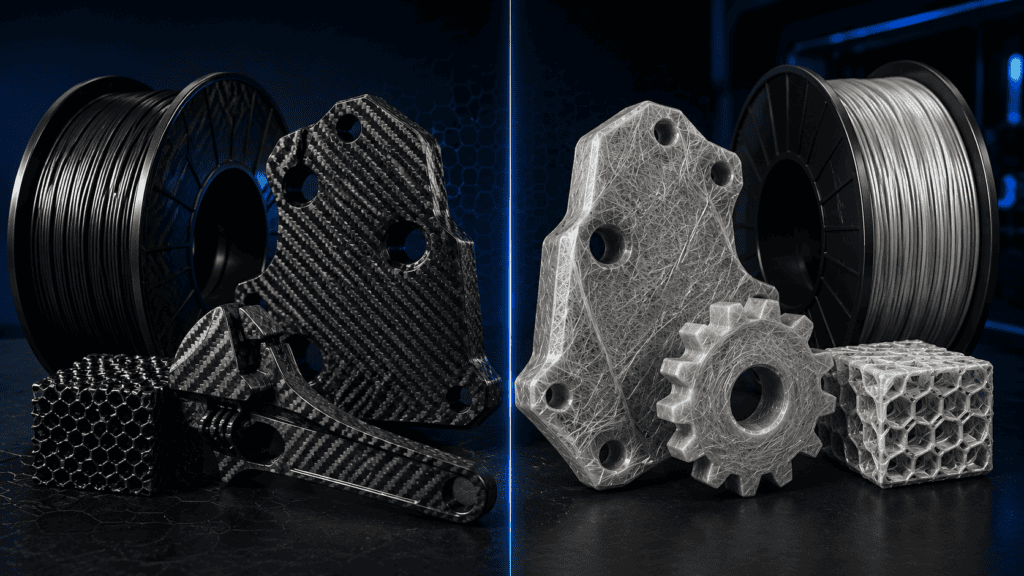
Quick answer: Short carbon fiber (CF) is commonly chosen for stiffness, dimensional stability and a clean matte technical finish. Glass fiber (GF) can provide excellent reinforcement and is often attractive for rugged functional parts. Neither one guarantees a universally stronger print, because the base polymer and the direction of the printed layers still matter enormously.
First: desktop CF and GF are usually short-fiber composites
When a spool says PETG-CF, PA-CF or PA-GF, it normally means chopped fibers are mixed into the thermoplastic. That is very different from continuous-fiber composite manufacturing. The fibers are short and flow through the nozzle with the polymer.
They can change shrink behavior, stiffness, surface texture, dimensional stability and sometimes heat performance, but they do not erase the anisotropy of FDM printing. Layer bonding is still a critical design factor.
Carbon fiber: why it feels so “technical”
CF-filled filaments often feel noticeably stiffer than their unfilled equivalents. They can also warp less because the fibers reduce how much the polymer moves during cooling. For jigs, fixtures, housings and precision brackets, this can make a part feel much more engineered.
Many CF blends also produce a matte surface that hides layer lines well. That appearance is a real reason CF has become popular for visible functional parts.
Glass fiber: less fashionable, still very useful
GF reinforcement can offer high rigidity and dimensional control without necessarily targeting the premium matte aesthetic of CF. Depending on the polymer and fiber loading, GF can be a very practical choice for fixtures, structural components and parts where appearance is secondary.
Some GF formulations may preserve impact characteristics differently from CF versions, but there is no universal rule. Compare data sheets for the exact grade rather than assuming “GF is tougher” or “CF is stronger.”
Comparison
| Characteristic | CF-filled | GF-filled |
|---|---|---|
| Stiffness | Usually excellent | Usually excellent |
| Surface | Often fine matte | Often more visibly textured |
| Dimensional stability | Often improved | Often improved |
| Abrasive? | Yes | Yes |
| Hardened nozzle | Recommended/required | Recommended/required |
| Best choice determined by | Base polymer + formulation + application | |
The base polymer is more important than CF vs GF
This is the rule worth remembering. PLA-CF and PPA-CF are not competitors simply because both contain carbon fiber. PLA-CF may print easily and look excellent, but its thermal behavior is still fundamentally PLA-like. PPA-CF belongs to a completely different high-performance class.
The same applies to PETG-GF versus PA-GF. Decide what polymer family your part needs first, then decide whether reinforcement improves the properties you care about.
You need wear-resistant hardware
Carbon and glass fibers are abrasive. Prusa explicitly recommends a hardened nozzle for composite materials filled with carbon, glass or Kevlar. A brass nozzle can gradually wear larger, changing line width, flow behavior and dimensional accuracy without an obvious sudden failure.
What else can wear?
- Soft extruder gears
- Filament guides and PTFE paths over very high usage
- Small nozzle orifices when heavily filled material carries longer fibers
0.4 or 0.6 mm nozzle?
Many commercial filled materials work with 0.4 mm nozzles, but 0.6 mm is a very practical size for composite printing. It gives fibers more clearance, supports higher flow and is often a good match for the functional parts these materials are used to make.
Moisture still matters
Adding fibers does not make a hygroscopic base polymer stop absorbing moisture. PA-CF and PPA-CF in particular demand careful drying and storage. PETG-CF also benefits from being dry when you want a clean consistent surface.
Use the free Techmins Filament Selector to rank materials by heat, UV exposure, strength, flexibility and printer capability.
When I would choose CF
- A visible functional part where matte appearance matters.
- A fixture where stiffness and low flex are priorities.
- A part where improved dimensional feel is more valuable than maximum impact compliance.
When I would actively compare GF
- Industrial-looking brackets and fixtures where cosmetics are secondary.
- A manufacturer offers strong mechanical data for a GF grade at a better cost.
- You want an alternative reinforcement in the same polymer family.
Bottom line
Do not buy “carbon fiber filament” as a category. Buy a specific polymer formulation for a specific job. CF and GF are modifiers, not magic ingredients. Start with the required temperature, chemical, UV and toughness behavior, then use fiber reinforcement to tune stiffness, dimensional stability and finish.