
Introduction
Get ready to be amazed! Anthropic is proud to announce the arrival of the Claude 3 model family, a groundbreaking suite of AI assistants that sets new industry standards across a range of cognitive tasks. This isn’t just another AI assistant; Claude 3 represents a paradigm shift.
The Claude 3 family comprises three tiers of models, each designed with a specific user in mind. Claude 3 Haiku prioritizes speed and affordability, making it ideal for everyday tasks and quick solutions. Sonnet offers a balanced approach, delivering robust performance at a moderate cost, perfect for businesses seeking to optimize workflows. Finally, Claude 3 Opus stands as the pinnacle of intelligence within the lineup, tackling complex challenges with unmatched prowess.
This tiered approach empowers users to choose the Claude3 that best suits their needs, whether it’s cost-effective assistance or cutting-edge problem-solving capabilities. Opus and Sonnet are already available for exploration on claude.ai and the Claude API, with a global reach spanning 159 countries. Haiku will be joining them soon, further expanding the potential of the Claude 3 family.
Under the Hood of Claude3
Claude3 isn’t your average AI assistant. This latest creation from Anthropic boasts a unique blend of technologies that propel it to the forefront of AI development. Let’s look into the fascinating world beneath the hood of Claude3 and explore what makes it tick.
Technology Behind Claude3
- Multimodal Marvel: Unlike its predecessors, Claude3 can not only understand and respond to text, but it can also process visual data like images, charts, and graphs. Imagine feeding Claude3 a complex scientific diagram and getting a clear explanation in return! This multimodal capability unlocks a whole new range of applications.
- Reasoning Powerhouse: Claude3 excels at logical reasoning, mathematical calculations, and coding tasks. Think of it as having a built-in super-powered problem solver that can tackle complex challenges across various disciplines.
- Constitutional AI: Anthropic emphasizes the responsible development of AI. Claude3 is trained using a framework called “Constitutional AI” that aligns its responses with human values and principles. This helps ensure Claude3 operates ethically and avoids generating harmful content.
What Can Claude3 Do?
Claude3’s capabilities extend far beyond setting alarms or playing music. Here’s a glimpse of its potential:
- Revolutionize Research and Development: Imagine scientists collaborating with Claude3 to analyze complex data, generate new hypotheses, and accelerate scientific breakthroughs.
- Boost Productivity: Claude3 can assist with tasks like writing, editing, summarizing information, and even generating creative text formats. This frees up valuable time for users to focus on more strategic work.
- Break Down Language Barriers: Claude3 exhibits fluency in multiple languages, making it a valuable tool for global communication and collaboration.
- Democratize Expertise: Claude3’s ability to understand complex topics can make specialized knowledge more accessible to the average person.
This is just a taste of what Claude3 can offer. As research and development continue, we can expect even more exciting applications for this powerful AI assistant.
Also Read: Beginner’s Guide to Build Large Language Models from Scratch
Claude3: Evaluating Strengths and Weaknesses
Claude3 stands at the forefront of the AI landscape, offering a blend of cutting-edge capabilities and nuanced considerations. Let’s examine its strengths, weaknesses, and its position in the market.
Claude3 vs Other AI: Strengths
Champion of Intelligence
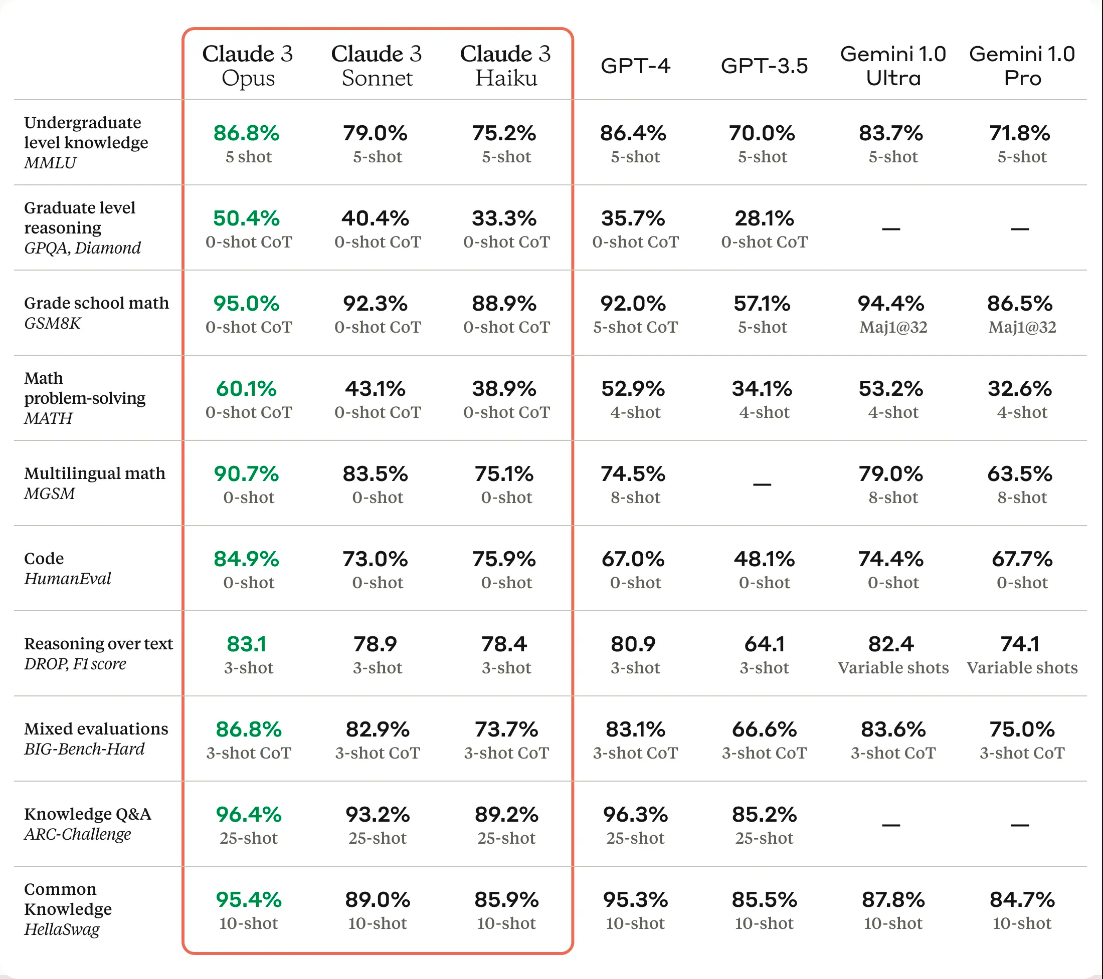
Claude3, particularly the Opus model, shines brightly on industry benchmarks, excelling in tasks ranging from reasoning to mathematics and coding. This prowess positions it as an invaluable asset for professionals requiring high-level problem-solving.
Multimodality Magnified
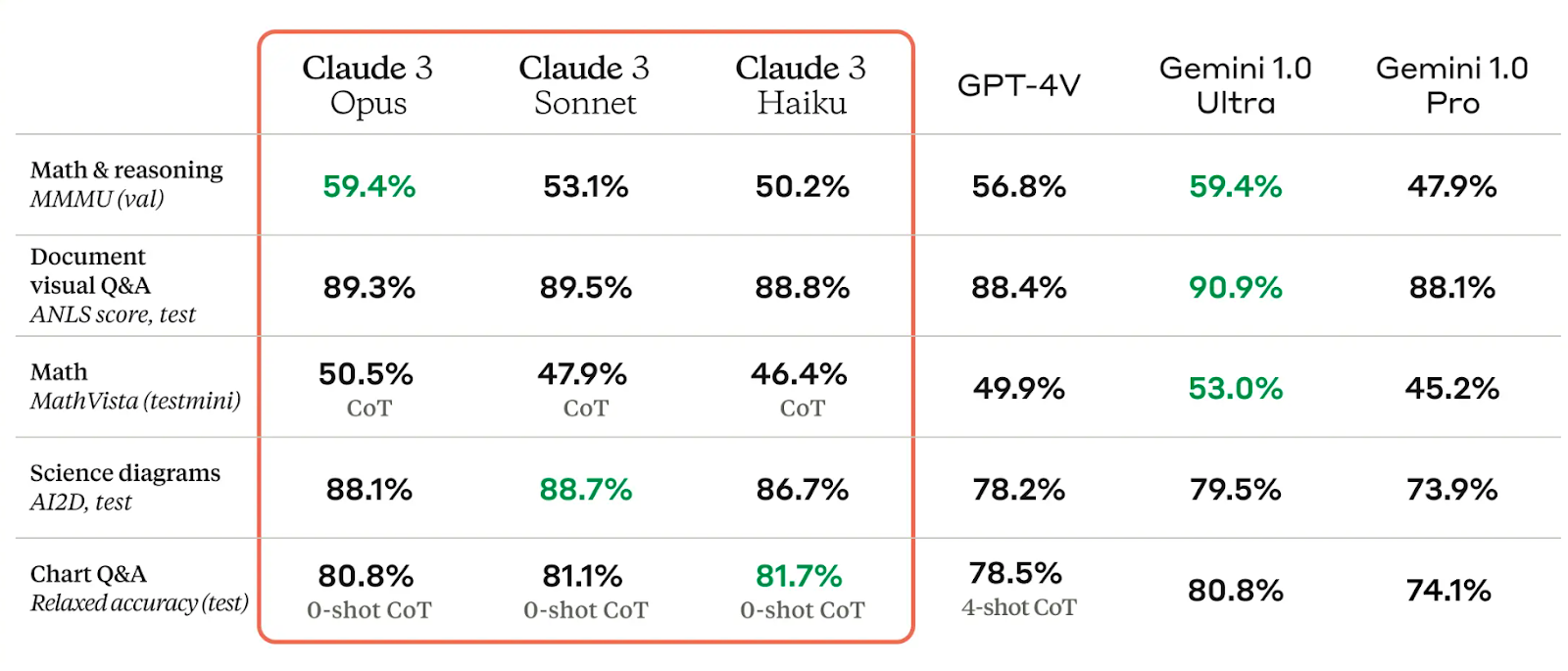
Unlike its predecessors, Claude3 transcends text-based limitations, adeptly processing visual data like charts, graphs, and scientific diagrams. This expands its utility significantly, particularly in the research and development context
Specialized Solutions
Claude3 offers a range of specialized models tailored to various needs:
- Claude 3 Opus: The pinnacle of intelligence within the Claude3 lineup, Opus demonstrates unparalleled performance on highly complex tasks. Its ability to navigate open-ended prompts and sight-unseen scenarios with human-like understanding pushes the boundaries of generative AI. Opus is priced at $15 per million tokens for input and $75 per million tokens for output, with a context window of 200K tokens. Potential uses include task automation, R&D, and strategy, among others. Opus stands out for its superior intelligence compared to other models.
- Claude 3 Sonnet: Balancing intelligence and speed, Sonnet is optimized for enterprise workloads. It offers robust performance at a lower cost, making it ideal for large-scale AI deployments. Sonnet is priced at $3 per million tokens for input and $15 per million tokens for output, with a context window of 200K tokens. Potential uses include data processing, sales tasks, and time-saving operations. Sonnet’s affordability and scalability make it a standout choice.
- Claude 3 Haiku: Designed for speed and efficiency, Haiku delivers near-instant responsiveness at a fraction of the cost. Priced at $0.25 per million tokens for input and $1.25 per million tokens for output, with a context window of 200K tokens, Haiku excels in customer interactions, content moderation, and cost-saving tasks. Its unmatched speed and affordability set it apart in its intelligence category.
Global Communication Powerhouse
Fluency in multiple languages enhances Claude3’s role as a tool for global collaboration and communication, fostering synergy in diverse settings.
Safety First Approach
Anthropic’s commitment to safety ensures that Claude3’s models are equipped to handle misinformation, bias, and safety hazards, addressing critical ethical concerns.
User-Friendly Design
Improved adaptability and adherence to user guidelines make Claude3 a more user-friendly AI assistant, streamlining interactions for enhanced usability.
Claude3 vs Other AI: Weaknesses
Cost Considerations
While Claude3 offers budget-friendly options like the Haiku model, the Opus model’s higher price tag could limit accessibility, particularly for individual users or smaller organizations.
Availability Matters
Limited availability, with models like Haiku still under development and Opus requiring a paid subscription, may impede widespread adoption, affecting market penetration.
Transparency and Explainability
Concerns persist regarding the transparency and explainability of Claude3’s responses, given the inherent complexity of AI models. This could pose challenges, especially in scenarios requiring clear reasoning.
Overall Assessment of Claude3 vs Other AI
Claude3 presents a compelling blend of intelligence, versatility, and safety, positioning itself as a formidable AI player. However, considerations regarding cost, availability, and transparency necessitate careful evaluation. As Claude3 evolves, addressing these weaknesses will be pivotal for ensuring its long-term success and widespread adoption.
Conclusion
Claude3’s arrival signifies a leap forward in AI, offering a future brimming with possibilities. From scientific breakthroughs to streamlined communication, its potential to revolutionize various fields is undeniable. However, responsible development remains crucial. Transparency and mitigating bias are key to building trust and ensuring ethical integration. As we explore Claude3’s capabilities, collaboration with AI, not competition, will be the key to maximizing its positive impact. By harnessing this power responsibly, we can unlock a future of progress, innovation, and a deeper understanding of the world around us.
Let us know your thoughts in the comment section below!
Stay tuned to Analytics Vidhya Blogs to know more about latest advancements in the world of GenAI.