
In May 2023, the city of Muscatine, Iowa embarked on an ambitious plan to construct 3D printed homes. The weekend before Thanksgiving, the first such home was demolished.

3D Rendering of a home by Alquist
This project, a collaboration between the Community Foundation of Greater Muscatine (CFGM), Muscatine Community College, and Alquist 3D, received a $1.8 million award for the construction of 10 3D printed homes throughout the city. Envisioned as a solution to the pressing housing challenge in the community, the 10 planned 3D-printed homes will each bear a price tag of approximately $300,000 upon completion. Six of those homes were to be reserved for first time homebuyers with a preference for educators.
The printed home was designed to be 1,300 square feet with 3 bedrooms, 2 bathrooms, a front porch and attached two-car garage. The home would utilize traditional wooden frames from the interior walls. The original plan was to for all ten homes to be constructed from May through the end of 2023. The CFGM originally estimated that the base of each home could be printed in about 12 days while the rest of the finishes would take 6-10 weeks.
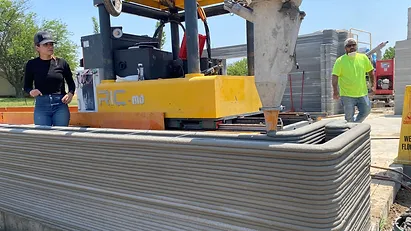
Walls of Muscatine’s first 3D printed home being printed on site
It’s not clear what other issues might have derailed this timeline—construction has only just started on the second home—but the largest culprit appears to be the choice of printing material for the project: hempcrete. Made by combining hemp fibers and other additives with concrete, hempcrete is an increasingly popular building material throughout Europe.
While hempcrete is not as proven a printing material as standard concrete mixes, it held a special appeal for this project: Muscatine Community College is home to Iowa’s only hemp program. A stated goal for the project was to have MCC students conduct research on hemp’s properties as a building material as well as for MCC to work with Alquist to develop a 3D printed construction curriculum.
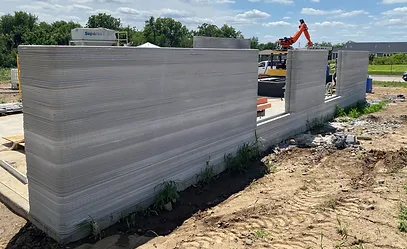
3D home printing in Arbor Commons in Muscatine
Unfortunately, the CFGM disclosed in September that, despite the hempcrete formula passing lab tests, it failed to meet the same standards on-site. When construction began in May, Alquist CEO Zachary Mannheimer claimed the concrete mixture selected for the project could reach a PSI of 6,000 to 8,000. During quality tests conducted by IMEG, the substance was not consistently able to reach the minimum 5000 PSI threshold needed.
Project participants concluded that it would be best to demolish what had been constructed and rebuild later. Alquist 3D, the subcontractor, will absorb the costs of this reconstruction, sparing future homeowners any impact on the listing price. The new concrete formula is meeting the required 5000 PSI threshold and construction on the second home will resume this spring. CFGM emphasized in a September statement that the intention is still to build ten homes.
Subscribe to Our Email Newsletter
Stay up-to-date on all the latest news from the 3D printing industry and receive information and offers from third party vendors.