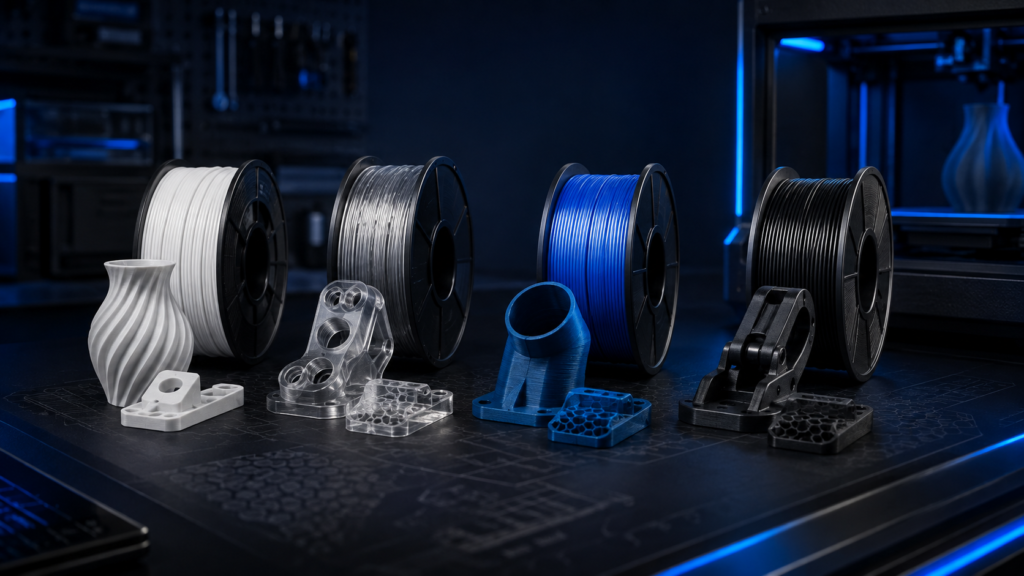
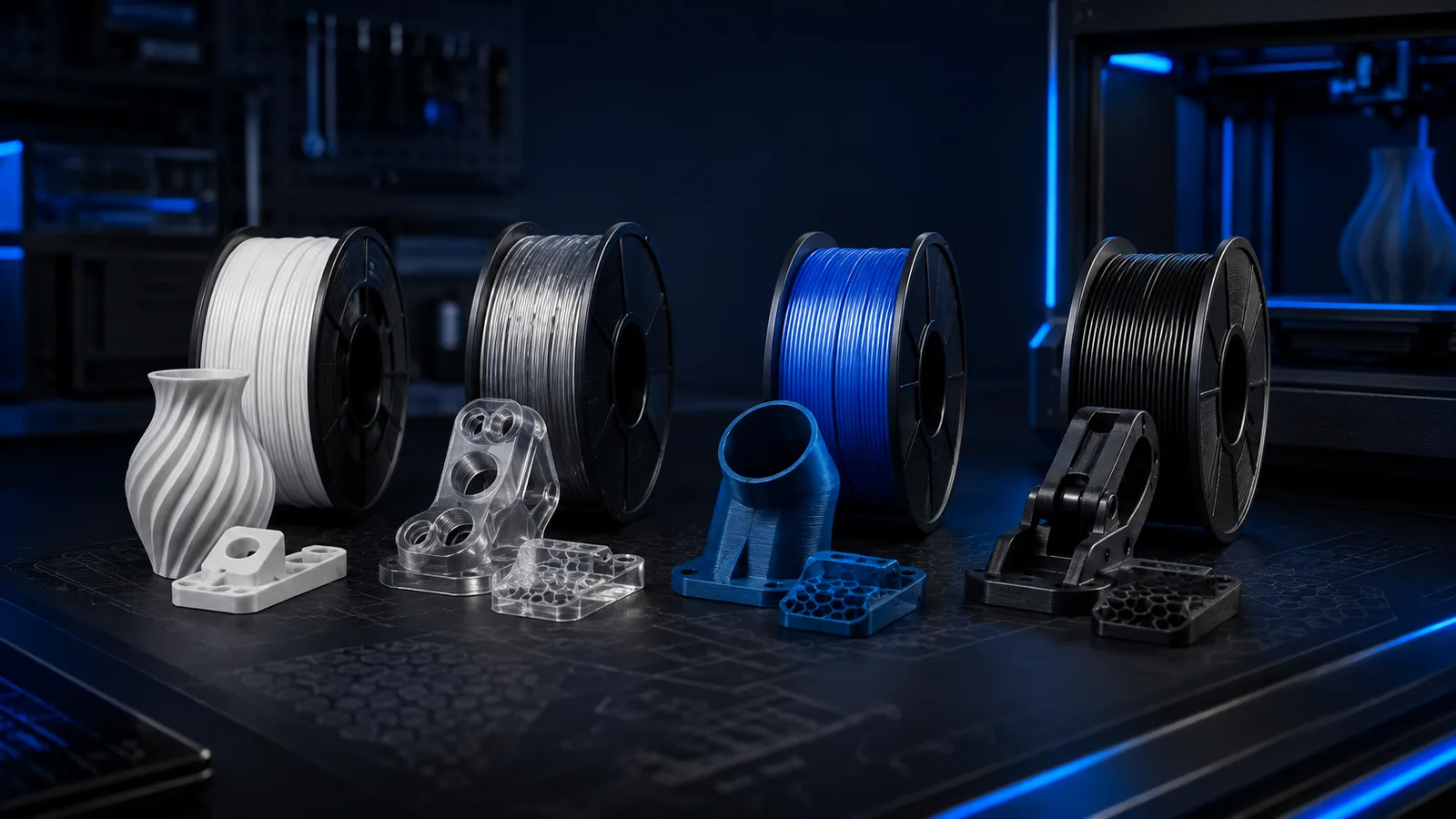
Quick answer: Use PLA when easy printing, stiffness and appearance matter most. Choose PETG for general-purpose functional parts that need more toughness and temperature resistance. Use ASA for outdoor parts and applications where UV/weather resistance matters. ABS is still useful for tough engineering parts and solvent finishing, but it usually needs an enclosure and good ventilation.
The important part is not deciding which filament is “best.” It is matching the material to the environment, load and printer. A beautifully printed PLA bracket can still fail if it spends summer inside a hot car, while an unnecessarily difficult engineering polymer can waste time and money on a simple desk organizer.
At-a-glance comparison
| Material | Print difficulty | Heat | Outdoor / UV | Toughness | Typical use |
|---|---|---|---|---|---|
| PLA | Easy | Low | Poor | Moderate / relatively brittle | Models, prototypes, organizers |
| PETG | Easy–medium | Medium | Moderate | Good | Functional indoor parts, brackets, housings |
| ASA | Medium–hard | Good | Excellent | Good | Outdoor parts, automotive trim, housings |
| ABS | Medium–hard | Good | Limited vs ASA | Good | Engineering parts, enclosures, solvent-finished parts |
PLA: still the easiest starting point
PLA remains popular because it is forgiving. It normally needs little bed heat, does not shrink aggressively and produces sharp details. That makes it excellent for prototypes, decorative pieces, storage systems, cosplay parts and many lightly loaded indoor components.
Its weakness is sustained heat. A PLA part does not need to melt to fail: it can soften or creep under load well below normal extrusion temperatures. That is why a part that works perfectly on a desk can deform in a parked car, near a heater or inside an electronics enclosure.
Choose PLA when:
- You want the simplest printing experience.
- Dimensional detail and surface quality matter.
- The part stays indoors and relatively cool.
- You are making prototypes, models or low-stress functional parts.
PETG: the everyday functional all-rounder
PETG trades some of PLA’s crispness and rigidity for better toughness and useful temperature resistance. It is a strong default for brackets, covers, printer accessories, clips, household parts and other components that should survive more abuse than a typical PLA print.
Its common annoyances are stringing, moisture sensitivity and a slightly softer surface. PETG also likes to stick aggressively to some build surfaces, so the correct plate preparation matters.
Choose PETG when:
- You need a practical functional part without moving to an enclosed-printer material.
- Some flex before failure is useful.
- The part may see moderate warmth or moisture.
- You want a relatively easy material with broader use than PLA.
ASA: the outdoor specialist
ASA is one of the most useful mainstream materials for outdoor prints. It combines mechanical properties similar to the ABS family with much better resistance to sunlight and weathering. For exterior brackets, garden equipment, outdoor housings and vehicle-related parts, that matters more than a small difference in laboratory tensile strength.
The downside is process control. ASA shrinks as it cools, so large prints benefit strongly from an enclosure and stable ambient temperature. Ventilation is also important when printing styrenic materials.
Choose ASA when:
- The finished part lives outdoors.
- UV resistance matters.
- You need better heat performance than PLA/PETG.
- Your printer can control drafts and warping.
ABS: still relevant, but ASA often replaces it outdoors
ABS is not obsolete. It is tough, machinable and can be solvent-smoothed with appropriate techniques. It remains common in industrial products. For desktop printing, however, ASA often provides a more compelling package when the part may see sunlight.
Like ASA, ABS benefits from an enclosure and controlled cooling. Very large parts can split between layers if the surrounding air is too cold or drafty.
What about HT PLA, CF/GF and engineering filaments?
Modern filament choices extend far beyond these four. HT PLA can offer PLA-like printability with better thermal performance, sometimes after annealing. PETG-CF and PETG-GF improve stiffness and dimensional feel. PA-CF and PPA-CF move into much more demanding engineering territory.
Do not select those materials just because they sound stronger. Filled filaments are abrasive, higher-temperature polymers may require an enclosure, and moisture control becomes increasingly important.
Use the free Techmins Filament Selector to rank materials by heat, UV exposure, strength, flexibility and printer capability.
Application-first recommendations
- Display model: PLA
- Indoor bracket: PETG
- Outdoor sensor housing: ASA
- Part for a warm vehicle interior: ASA or a suitable heat-resistant engineering material
- Very rigid technical fixture: consider CF/GF-reinforced material
- High-temperature mechanical component: PA-CF, PC-based material or PPA-CF may be more appropriate
Common mistake: comparing only nozzle temperature
Nozzle temperature tells you how the polymer is processed, not how hot the finished part can safely operate. A filament printed at 260 °C does not automatically tolerate a 200 °C service environment. For critical parts, check the manufacturer’s technical data sheet and look for heat-deflection, Vicat or other relevant thermal data.
Bottom line
For most printers, PLA, PETG and ASA cover an enormous percentage of real jobs. PLA wins for ease and detail, PETG for everyday function, and ASA for weather exposure. ABS remains useful, but it should be chosen for a reason rather than by habit. Move into reinforced and high-temperature materials only when the application gives you a clear benefit.
The 3D Printing Cost Calculator includes filament, waste, electricity, machine depreciation, labor and margin.