
As part of getting to grips with the new world of agentic engineering,
I built an application to support my work. It’s a sophisticated app:
high-quality web UI with dynamic refresh and look-up, modals and
auto-save, integrations to external systems, machine learning and text
analysis, background jobs, and a proper environment setup with fully
automated deployment. It’s approximately 150,000 lines of code,
primarily in Rust (~120 kLoC) with the remainder in TypeScript and
Terraform.
This was entirely written by agents. Mostly Claude Code, and some use
of Cursor. I didn’t read or review any of the code, except
occasionally, out of interest.
While building the application, I could see some things going
awry. After watching an edit to line 4,000 of a file scroll by in the
terminal, I had a closer look. The data access layer had grown to over
6,000 lines. As more features landed, this continued to
grow. Every query, read or write, repeated the same HTTP request
setup, the same JSON encoding and decoding. Eventually, it reached 17,155
lines. In a single Rust file.
An experiment in refactoring
The 17,155 line file was the entire data access layer. A single,
self-contained module. Reviewing the code, there was no
de-duplication, no internal language, limited extraction of functions,
and very little extraction of classes. It did have a clear boundary
with an interface to preserve. It was a great target for refactoring.
The goal of refactoring an agentic code base is to spend tokens now in
refactoring to make token consumption for future work lower. An
experiment should be able to show that as this file was refactored the
token cost of making separate feature implementations in this code
base would decrease.
Precisely because agents never learn this was now possible to run as
an experiment. I could prompt a fresh agent to make exactly the same
change after every refactoring stage. Unlike a human engineer, the
experiment would not be tainted by learning from previous steps.
- Create an overall refactoring plan, following strict refactoring
discipline. - Craft a representative change, described in a single prompt.
- Establish a baseline cost of change: in a sub-agent, execute that
prompt, including asking the sub-agent to report token consumption. - Throw away the change.
- In a loop:
- Apply a single step of the overall refactoring.
- In a sub-agent, execute exactly the same change receiving the
token cost of the change. - Throw away the change.
- Record all token costs, time to execute the change, and lines of
code after each step of the refactoring, including the baseline.
The prompt used for the representative change and the refactoring
steps applied are shown in the appendices, below.
One caveat: Claude doesn’t provide reliable methods for counting
tokens live despite showing token counts, reporting tokens consumed
per session, and billing for tokens. I’m assuming this is a
temporary issue that will improve over time. Instead, the sub-agent
reported the number of characters received and sent and used
tiktoken to approximate tokens, by dividing character count by
four.
Results
| Step | Data Access Layer LoC | Largest file LoC | Total Rust LoC | Input tokens per change | Output tokens per change | Time per change (s) |
|---|---|---|---|---|---|---|
| Baseline | 17,155 | 17,155 | 50,359 | 159,564 | 1,705 | 342 |
| Step 1 (FirestoreClient) | 16,706 | 16,706 | 49,910 | 155,205 | 1,723 | 530 |
| Step 2 (extract_doc_id, new_link) | 16,562 | 16,562 | 49,766 | 159,227 | 2,105 | 574 |
| Step 3 (link-query helpers) | 16,567 | 16,567 | 49,771 | 154,054 | 2,105 | 524 |
| Step 4 (FakeStore predicates) | 16,577 | 16,577 | 49,781 | 154,146 | 2,060 | 654 |
| Step 5 (value ctors) | 16,469 | 16,469 | 49,673 | 171,251 | 2,036 | 1,353 |
| Step 6 (FieldsBuilder) | 16,469 | 16,469 | 49,673 | 171,251 | 2,036 | 1,353 |
| Step 7 (queries.rs) | 16,474 | 15,670 | 49,678 | 151,850 | 1,800 | 587 |
| Step 8 (traits.rs) | 16,508 | 13,845 | 49,712 | 132,558 | 1,723 | 446 |
| Step 9 (traits/ split) | 16,508 | 13,845 | 49,712 | 132,558 | 1,723 | 446 |
| Step 10 (codec.rs) | 16,521 | 12,846 | 49,725 | 131,871 | 1,750 | 540 |
| Step 11 (fake_store.rs) | 16,535 | 11,122 | 49,739 | 133,016 | 2,460 | 600 |
| Step 12 (store/ split) | 16,550 | 9,269 | 49,754 | 104,080 | 2,050 | 490 |
| Step 13 (co-locate tests) | 16,550 | 9,269 | 49,754 | 104,080 | 2,050 | 490 |
| Step 14 (complete fake_store.rs) | 16,553 | 7,225 | 49,757 | 107,205 | 2,453 | 523 |
| Step 15 (store/ split) | 16,608 | 3,695 | 49,812 | 27,360 | 2,113 | 454 |
The interesting metrics here are the total lines of code in the data
access layer, the total lines of code in the largest single file in
the data access layer and the input tokens consumed while producing
the change.
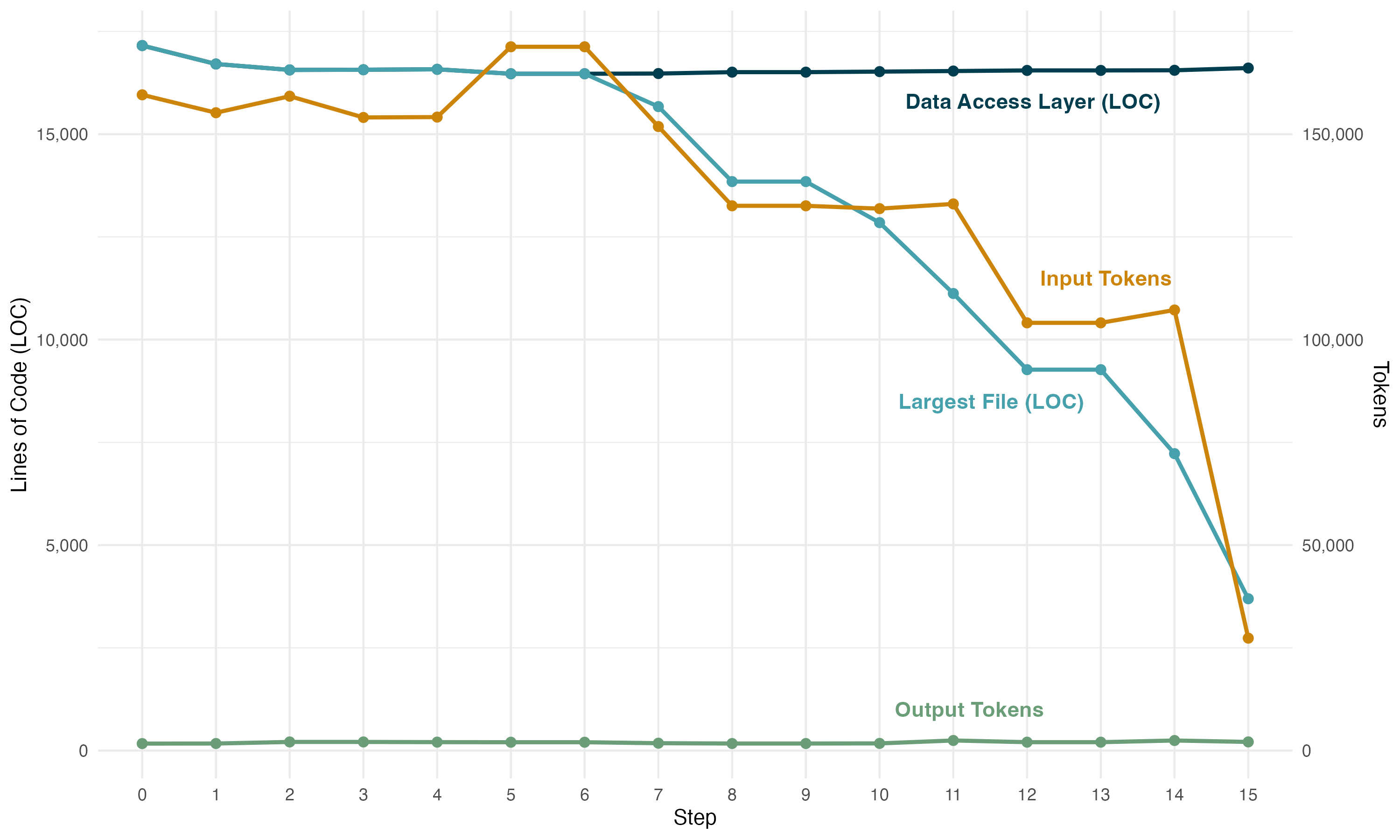
This chart shows four things. The first point is the baseline, step 0,
and then the same metrics are repeated after each refactoring step
has been applied.
- The total lines of code in the data access layer as a
whole. Initially, this is just the single file I started with. This
becomes many files as refactorings are applied. By the end there
are 19 Rust files. - The lines of code in the single largest file in the data access
layer. This started as the entirety of the data layer in the single
initial file. By the end, the single largest file is a test
library. Further refactoring passes could apply the same approach
to this. - The total input tokens consumed by the sub-agent while applying the
representative change. - The total output tokens produced by the sub-agent while applying
the representative change.
Refactoring reduces token consumption
The results are clear. Input tokens stay fairly flat until the largest
file starts to fall, and then they drop before, in the words of
Claude, falling off a cliff.
Between the base line and the final refactoring, input tokens for the
same task reduced from 159,564 to 27,360. A saving of
132,204 tokens, or 83%. And that saving is not a one-off. Every single
change that touches the data access layer from this point forward now
costs significantly less.
How much of a saving? Assuming Sonnet 5 pricing at the time of writing
of $3/MTok, 39.7 cents. Not a lot. Does it multiply? How will this
play out across debugging? More complicated features? This is
refactoring only one portion of the code base, can the whole code base
be aggressively refactored to find savings everywhere? How much would
those refactorings cost?
This saving is because the agent has to read less code. But it is not
because there is less code to read. The overall code in the data
access layer as a whole has stayed fairly constant. Therefore to be
able to bank this saving, the agent must be able to successfully
identify the smallest subset of files necessary to read. The results
make it appear this was happening. Reading the Claude Code thinking
output and file read summaries as the change was being applied also
indicates the sub-agent was successfully reading smaller and smaller
sections of code each time.
In other words, randomly cutting the file into smaller files is
unlikely to help as much: even if each file were smaller, the agent
would be forced to read through many files looking for the relevant
code. While the step with the biggest effect happens at the end, the
previous steps were refactorings to set up this saving. This was not
planned. It was simply a result of how refactoring typically proceeds:
local file changes to extract duplication, before breaking down into
smaller files once a repeating core emerges.
The refactoring did not make the representative change smaller. The
number of tokens produced when writing code was largely unaffected:
the output tokens do not move very much. Those tokens are five times
the price of the input tokens. But, there are a lot less of them. Are
there refactorings that could be applied to reduce output token
production? I need a more complex sample change to explore these
questions. The noise of the non-deterministic code generation process
is hiding any variance caused by changes in the factoring of the code.
Notes on the process
Claude was not good at refactoring. If you read the prompt and the
refactoring steps below, it’s clear that the refactorings produced
were directly in response to the prompt. Claude is unable to look at
code, look at refactorings in general and work out which are suitable
to apply: a human needs to actively guide it. This marries with wider
experience in this app. The development harness includes an explicit
refactoring step. That refactoring step did not prompt Claude into
improving this file. More anecdotally, Claude.ai was better than
Claude Code. I used both interfaces to create the refactoring
plan. Claude Code spotted extract function as the first
step. Claude.ai went further and saw an entire client class to be
extracted.
It was also bad at applying them. The mechanical act of refactoring
was performed by writing Python scripts using grep and sed. These
scripts frequently got confused by indentation. Oh, the irony. In
addition, the single most valuable refactoring was missed in the first
pass, and had to be re-applied as a follow-up step. This is why the
number of steps in the figure don’t match the refactoring steps in the
appendix.
It took about eight hours to complete the entire experiment. This was
mostly unattended. The only intervention was after six hours 40
minutes when it appeared to have finished, but had skipped that step
and needed to be redirected. This experiment was running on slow
hotel WiFi. I wondered if that contributed to time taken. But on
deeper analysis of the code base, the cargo temporary build cache had
become very large. Test execution was suffering, significantly.
Further work and broader implications
Unfortunately, it didn’t occur to me to perform a count of the tokens
required to create and execute the refactoring plan until it was
already complete. I’ve looked at my aggregate consumption across the
time window where I was doing this work, including designing and
running the experiment. I can’t say how many tokens were required to
perform the refactoring. The upper bound is five million,
however. This includes creating the refactoring plan twice, the work
to design the experiment including the representative change, and
various other tasks. Future work should include a more accurate count
of tokens consumed to refactor.
This is just one experiment, on a significant application that is
still greenfield and built and maintained by a single developer. But,
I believe this is a potentially interesting first step. This effort
shows the value, in time and money of refactoring. As well as
measuring how expensive refactoring is. It would be interesting to
look at more complex changes, at wider refactoring, refactoring
continuously, and even the relative value of different refactoring
approaches.
This is just the beginning.
Appendices
Note: These appendices include the prompts that I used, and the
output that was returned. The only editing applied has been to remove
the specific code changes to be made. These are included without
editing to show how the agents were directed. There are no hidden
tricks. As such, there is some language in here that might be
confusing. The error is in the original.
The representative change
This is the recorded prompt that was fed to each sub-agent, there was
no further context supplied other than the code base and accompanying
architecture documentation. Every sub-agent was starting with exactly
the same information.
You are working in the Rust project at
~/dev/your-project-name.Add a new
ItemWatchStorepublic async trait to the Firestore layer, following existing patterns exactly. The trait must have three methods:
async fn watch_item(&self, item_id: &str, user_id: &str) -> Result<()>async fn unwatch_item(&self, item_id: &str, user_id: &str) -> Result<()>async fn watched_items_for_user(&self, user_id: &str) -> Result<Vec<String>>Watches are stored in a
item_watchesFirestore collection. Each document has fields:itemId(string),userId(string),createdAt(timestamp). There is no Rust struct for a watch record — the methods returnVec<String>(item ids).Implement the trait for both
FakeStore(using an in-memoryVec<(String, String)>field added toFakeStoreInner) andFirestoreStore(using the same HTTP patterns used for other store impls in this file).At the very end of your response, output exactly this JSON block (fill in real values):
{
  "files_read": [
    {"path": "src/firestore.rs", "chars": 123456},
    ...
  ],
  "response_chars": 7890
}
Do NOT commit the change. Stop after writing the code.
Refactoring steps
This is the prompt that was used to create the refactoring plan.
Following the strict definition that a refactoring is a provably
correctness preserving series of code edits, and using Martin
Fowler’s 2nd edition of Refactoring as the source, examine
@src/firestore.rs. This is a 17K LoC Rust file. No file should be
that long. It is almost certainly not using an internal language to
build and manage queries. Produce and describe, but don’t execute, a
sequence of refactorings that would massively reduce the line count
of that file, without changing the interface at all.
Following is the description of the refactorings applied, extracted
from the plan built and followed by Claude. The actual plan includes
predicted code changes. For each refactoring, the individual steps to
follow were listed. Each of those steps was individually testable, and
was individually tested. This is a stricter refactoring than most
human engineers would follow.
The steps listed here don’t line up directly with the measured changes
above as Claude skipped the most valuable single refactoring
(splitting out the store into sub-files) on the first pass and had to
complete that afterwards as two additional steps.
Fowler ref: Extract Class (7.5); Extract Function (6.1) for
each primitive
FirestoreStore currently conflates two responsibilities:
- Domain query orchestration — which query to run, which documents
to write, how to parse results into domain types - Firestore HTTP transport — auth headers, URL construction, JSON
encoding/decoding of Firestore wire types,
retry-on-PRECONDITION_FAILED
Fowler §7.5 calls for extracting a new class when you can identify a
coherent subset of a class’s data and behaviour. The transport
responsibility owns: client: reqwest::Client, project_id: String,
MetadataAuth, and documents_url() / auth_header(). Extract these
into a new FirestoreClient struct.
Estimated savings: ~1,200 lines in FirestoreStore impls;
FirestoreClient adds ~120 lines net.
Step 2 — Extract Function: extract_doc_id and new_link (Fowler §6.1)
Fowler ref: Extract Function (6.1)
-
extract_doc_id— The expression
doc.name.rsplit('/').next()?.to_string()appears verbatim at the
start of all 20parse_*_documentfunctions. Extract it. -
new_link— Building aLinkstruct withmetadata:and
HashMap::new()provenance: Noneand a fresh UUID appears 62
times. Extract a factory function.
Estimated savings: ~500 lines (62 × ~10-line structs → 62 ×
~2-line calls; 20 parse functions each lose 1 line of boilerplate).
Fowler ref: Extract Function (6.1)
Two sub-patterns recur inside the FirestoreStore trait impls after running a link query:
-
Pattern A — collect all link documents from query rows (~15
sites). -
Pattern B — query links and return exactly one target ID, error if
missing (~8 sites):
Estimated savings: ~200 lines.
Fowler ref: Extract Function (6.1)
Inside the FakeStore impls, ~15 methods repeat variations of
inner.links.iter()....
Extract two methods on FakeStoreInner. The 15 callsites then become
single-line. Methods that additionally filter by a second predicate
(e.g. also checking to_kind) chain .into_iter().filter(…) on the
result of the helper.
Estimated savings: ~120 lines.
Step 5 — Replace Inline Code with Function Call × 4: Firestore value constructors
Fowler ref: Replace Inline Code with Function Call (8.5)
Add four private free functions (file-level, not methods) before the
codec block. Replace all 128+ json!({"stringValue": …}) /
json!({"timestampValue": …}) etc. inline expressions with calls to
these functions. Each multi-word json macro call becomes a single
short call.
Estimated savings: ~80 lines (mostly from multi-line json macros collapsing to one-liners).
Fowler ref: Extract Class (7.3)
The ~20 encoder functions all follow this shape:
let mut fields = serde_json::Map::new();
fields.insert("foo".to_string(), str_val(&x.foo));
fields.insert("bar".to_string(), ts_val(x.bar));
json!({"name": path, "fields": fields})
Extract a small builder. Rewrite each encoder function to use the
builder. A ~40-line encoder shrinks to ~12 lines.
Estimated savings: ~500–600 lines across the 20 encoder functions.
Fowler ref: Move Function (8.1)
Convert src/firestore.rs to a module directory: rename to
src/firestore/mod.rs. Then create src/firestore/queries.rs and
move all 32 LinkQuery constants and the
LinkQuery/EqFilter/EqValue/Ordering/Direction type
definitions into it. Add pub(super) use queries::*; in mod.rs.
No behaviour changes; all callsites already reference names that were
in scope via the flat file.
Reduces mod.rs by ~800 lines.
Fowler ref: Move Function (8.1)
Move all 17 pub trait definitions (and their associated error types)
to src/firestore/traits.rs. Re-export them from mod.rs with pub.
use traits::*;
Reduces mod.rs by ~1,900 lines. Produces a ~1,900-line traits.rs
that needs further decomposition.
Step 9 — Move Function: split traits.rs into a traits/ module directory
Fowler ref: Move Function (8.1)
Convert src/firestore/traits.rs to a module directory by grouping the 17 traits into four domain-aligned files:
| File | Traits | Approx lines |
|---|---|---|
traits/planning.rs |
ConcentrationStore, GoalStore, ItemStore, NoteStore, PursuitStore, FocusPassStore |
~650 |
traits/content.rs |
CaptureStore, TagStore, UrlReferenceStore, DocumentStore, PaperStore |
~550 |
traits/people.rs |
ThoughtworkerStore, ExternalContactStore, CompanyStore |
~300 |
traits/system.rs |
SessionState, LinkStore, SuggestionStore, SuggestionVetoStore, OAuthTokenStore, MigrationLedger, EmbeddingStore, RuntimeConfigStore, SalesforceSyncStateStore |
~400 |
traits/mod.rs becomes a pure re-export file (~20 lines). Associated
error types (FocusPassError, SuggestionDecisionError, etc.) move
with the trait that produces them.
No trait definition changes, no callsite changes — only
relocation. Each resulting file is 300–650 lines.
Fowler ref: Move Function (8.1)
Move all document encoder/decoder functions (*_document,
parse_*_document, kind_str, parse_kind, parse_capture_source,
parse_outcome, etc.) plus FieldsBuilder and the value constructors
from Steps 5 and 6 into src/firestore/codec.rs. Make them
pub(super).
After Step 6 this module will be ~400–500 lines rather than ~1,200.
Reduces mod.rs by ~500 lines (post-Step-6).
Fowler ref: Move Function (8.1)
Move FakeStore, FakeStoreInner, and all 18 trait impl blocks for
FakeStore into src/firestore/fake_store.rs. Re-export FakeStore
from mod.rs with pub use fake_store::FakeStore;.
FakeStoreInner and helper methods stay private to the module.
Reduces mod.rs by ~4,700 lines.
Step 12 — Move Function: split FirestoreStore impls into per-trait files under src/firestore/store/
Fowler ref: Move Function (8.1)
Create src/firestore/store/mod.rs with FirestoreStore struct
definition, impl FirestoreStore (constructor + FirestoreClient
from Step 1), and MetadataAuth.
Then create one file per logical domain grouping.
Each file contains only use super::*; (or explicit imports) and the
trait impl block(s). No type definitions, no helpers. Helpers used by
multiple impl blocks stay in store/mod.rs.
Reduces what would be a ~10,000-line file into ten files of 120–650
lines each. mod.rs becomes a ~100-line re-export manifest.
Step 13 — Move Function: co-locate tests with their modules
Fowler ref: Move Function (8.1)
The existing #[cfg(test)] modules test specific domain areas and
belong with the modules created in Step 12 rather than in a single
tests.rs.Each test module moves inside a #[cfg(test)] mod tests { … block at the bottom of the target file, with
}use super::*; to
access the module’s internals. No test is changed, only relocated.
Any shared test fixtures (FakeStore::new, helper builders) that are
already in fake_store.rs are accessible via the existing use import chain.
super::fake_store::FakeStore
Reduces mod.rs by ~2,000 lines; each target file gains 200–700
lines of tests that are directly adjacent to the code they exercise.