
With a look towards how software will be created soon, the makers of Warp have announced it is open-sourcing the project, in a launch of what the company is calling Open Agentic Development.
“Our vision is to cultivate an ecosystem where human creativity and artificial intelligence collaborate transparently to ship superior software at unprecedented speeds,” Warp CEO Zach Lloyd, former engineering lead on the Google Docs Suite, wrote in the company announcement.
The idea is to work with the open source community to manage the agents and create a better Warp more quickly.
The company has added product improvements with the launch. Among them are support for a wider range of open source models, including Kimi, MiniMaz and Qwen, with a feature that routes tasks to the best model for that job. With Warp evolving from “just a terminal” to a full development environment with built-in agents, it is now easier for users to customize their Warp experiences however they would like. Last, the company is giving users. an agents programmatic control over settings and portability between devices, the company announced.
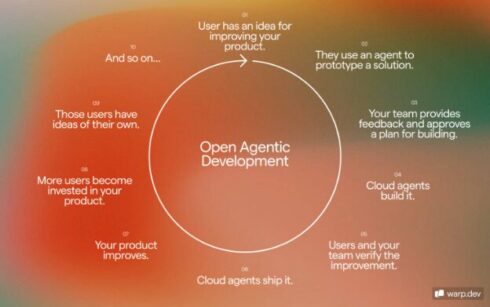
The core of the Open Agentic Development movement is a loop that begins with an idea, that then becomes an agent-led protoype that is refined, verified and ultimately approved for building by the team. The company uses Oz, its agentic infrastructure, to then build and ship the application. This process, according to the company, creates a kind of “flywheel of innovation,” where users of the product have feedback and ideas of their own that then kick off the cycle again.
Warp believes that humans managing agents at scale is the future of software and product development, and by bringing it to an open source community, more contributors can bring in ideas a closed development environment might not think of or try to create.
One of the keys to all this is the Oz platform for agentic orchestration. It is that underlying infrastructure that enables agents to plan, code and verify in the context of the codebase, while engineers shift from builders to assemblers of contributions from the broader community. Warp said its experience with Oz indicates that this kind of infrastructure can manage code more effectively than humans. “By using a strict ‘Spec and Verify’ process, we can ensure the codebase remains clean and robust,” the company wrote in its announcement.
OpenAI is the founding sponsor of the Warp repository; new agentic management workflows are powered. by GPT models. The source code is now available at github.com/warpdotdev/warp with an AGPL license.