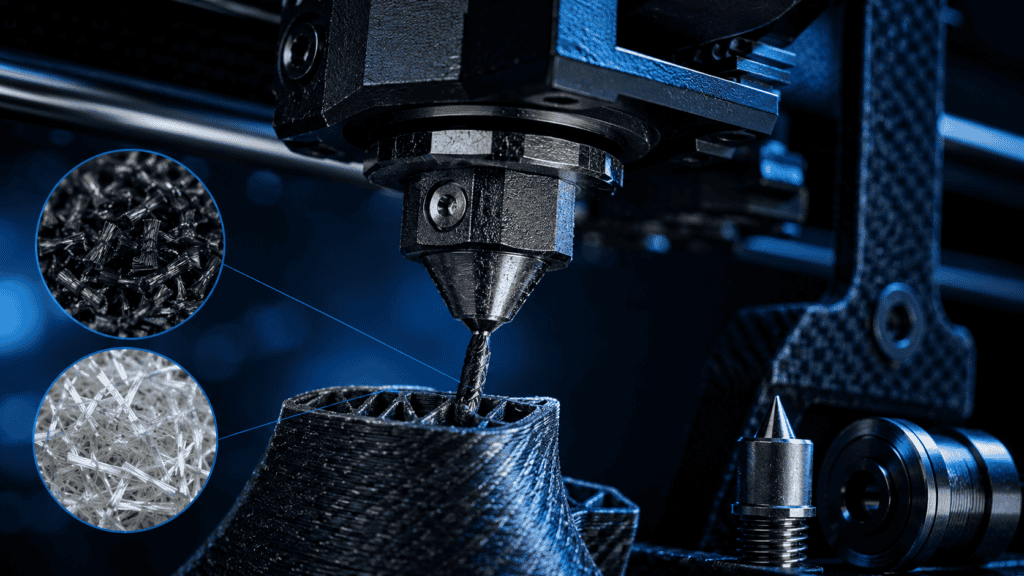
Fiber-filled filament can improve stiffness, dimensional stability and surface appearance, but the chopped fibers act like an abrasive moving through the nozzle. The damage is gradual, which makes it easy to miss until extrusion width and dimensions begin to drift.
- Brass is easy to machine and transfers heat well, but wears quickly with abrasive fillers.
- Hardened steel is common and affordable, but has lower thermal conductivity than brass.
- Tungsten carbide and other premium nozzles combine wear resistance with better thermal behavior.
- 0.6 mm is often safer for fiber-filled filament than 0.4 mm, depending on fiber length and manufacturer guidance.
- Wear affects extrusion diameter long before a nozzle looks obviously damaged.
Why CF and GF filaments are abrasive
Carbon fiber and glass fiber are added as short chopped strands or particles. These additives repeatedly scrape the internal bore and nozzle tip as the polymer flows through. Over time, the exit hole enlarges and the flat area around the tip can erode.
What nozzle wear looks like
- Extrusion lines become wider than expected.
- Dimensional accuracy drifts.
- First-layer tuning becomes inconsistent.
- Surface finish changes even with the same profile.
- Automatic nozzle-size assumptions no longer match reality.
Why brass is not ideal
Brass is popular because it conducts heat well and is inexpensive. For normal PLA, PETG and ABS it is excellent. With abrasive fillers, however, its softness becomes the weakness.
Hardened steel: the common upgrade
Hardened steel is much more wear-resistant and inexpensive enough for everyday use. The trade-off is lower thermal conductivity, which can slightly change the temperature/flow behavior compared with brass. Some users need a modest temperature increase for high-flow printing.
Premium wear-resistant nozzles
Tungsten-carbide, hardened alloy and coated specialty nozzles can offer better thermal performance and very high wear resistance. They cost more but can be attractive if abrasive materials are a major part of your printing.
| Nozzle type | Wear resistance | Thermal behavior | Best use |
|---|---|---|---|
| Brass | Low for abrasive filaments | Excellent | Standard unfilled materials |
| Hardened steel | High | Lower conductivity | Affordable abrasive-material use |
| Tungsten carbide / premium alloy | Very high | Often better than steel | Frequent abrasive printing |
Should you use 0.4 or 0.6 mm?
A 0.4 mm nozzle can work with many CF/GF filaments, but a 0.6 mm nozzle gives fibers more room to pass and generally reduces clog risk. Some manufacturers explicitly recommend 0.6 mm or larger for their filled materials, so check the spool documentation.
Fiber length matters
Not all “CF” filaments use the same chopped-fiber size or loading. A material optimized for easy desktop printing may behave very differently from a heavily filled engineering filament. Do not assume one nozzle rule applies to every brand.
Hardened extruder gears may also matter
Abrasive material does not only touch the nozzle. On some printers, frequent fiber-filled use can also wear soft feed gears or filament-path components. Many modern printers designed for composites already include hardened drive components.
Temperature tuning after a nozzle change
Switching from brass to hardened steel can change how heat reaches the polymer. If extrusion becomes inconsistent at the same flow rate, test a small temperature increase within the filament manufacturer’s range rather than immediately raising extruder tension.
Flow limits can change too
A wear-resistant nozzle with poorer conductivity can reduce the maximum flow your hotend sustains at the same temperature. If you print fast, retest volumetric flow after changing nozzle material.
When should you inspect the nozzle?
- After several spools of abrasive filament
- When extrusion width changes unexpectedly
- If first-layer calibration suddenly needs unusual offsets
- When dimensional accuracy degrades without other profile changes
Can you switch back to brass for PLA?
Yes. Some users keep a hardened nozzle installed permanently, while others swap to brass for maximum thermal performance on ordinary materials. The right choice depends on how often you use filled filament and how convenient nozzle changes are on your printer.