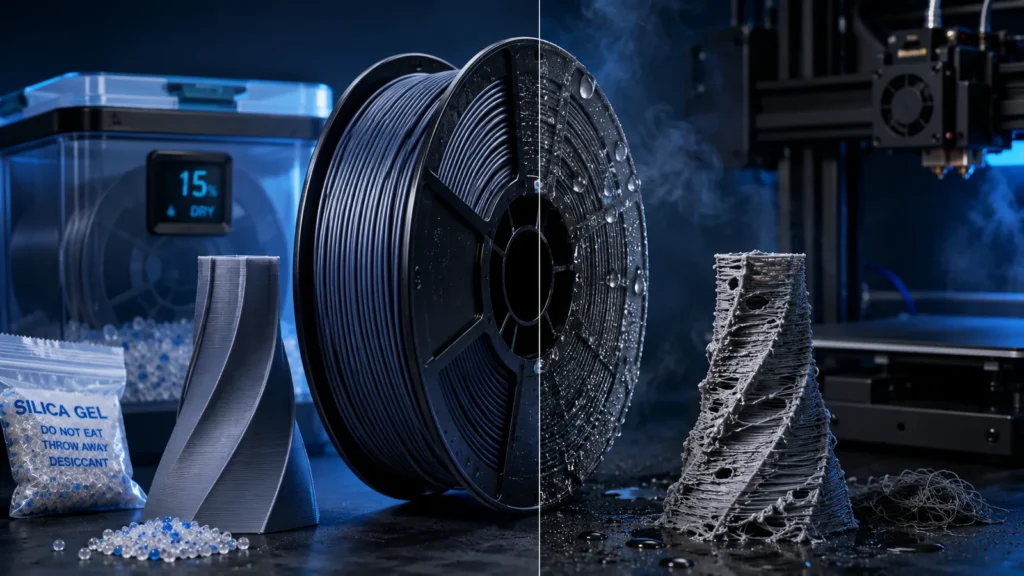
Moist filament does not always look wet. The spool can feel dry and still contain enough absorbed water to affect printing. This is why storage and drying are part of material handling, not just emergency fixes.
- Hygroscopic filaments absorb water from ambient air.
- Heat turns absorbed moisture into vapor during extrusion.
- Symptoms can include popping, foaming, roughness and stringing.
- Nylon and many engineering materials are especially sensitive.
- Drying temperature must match the polymer; too much heat can deform the spool or filament.
What “hygroscopic” means
A hygroscopic material attracts and absorbs water molecules from the surrounding air. The rate depends on polymer chemistry, humidity, temperature and how long the spool is exposed.
What happens inside the hotend
When moist filament enters a hot melt zone, absorbed water rapidly turns into vapor. Tiny steam bubbles can disturb the molten polymer, creating unstable extrusion and visible defects.
Common symptoms
- Popping or sizzling sounds
- Small bubbles or foam in extruded filament
- Rough or inconsistent surface finish
- Fine stringing or fuzz
- Reduced transparency in clear materials
- Weaker or less consistent parts
Not every symptom is moisture
A partial clog, unstable temperature, excessive nozzle heat or incorrect retraction can create similar defects. Drying is most convincing as a diagnosis when the same spool improves clearly after a proper drying cycle.
| Material family | Typical moisture sensitivity | Storage priority |
|---|---|---|
| PLA | Low to moderate | Useful for long storage |
| PETG | Moderate | Recommended |
| TPU | Moderate to high | Important |
| Nylon / PA | High | Critical |
| PPA / engineering nylons | High | Critical |
Why nylon can change quickly
Polyamide-based materials can absorb significant moisture and may deteriorate after relatively short exposure in humid environments. High-performance filled nylons are not exempt; the fiber may reduce some dimensional behavior, but the polymer matrix can still be hygroscopic.
Does PLA need drying?
PLA is generally more forgiving, but old or poorly stored PLA can still absorb enough moisture to affect surface finish or consistency. If a spool has been open for months in a humid room, drying is a reasonable diagnostic step.
PETG and stringing
Moisture can make PETG stringing harder to tune because steam and inconsistent melt behavior add variables that retraction settings cannot solve. Dry PETG before chasing extreme retraction values.
Drying is not the same as storage
Desiccant in a sealed box helps keep dry filament dry. It is not always powerful enough to remove substantial moisture already absorbed into the polymer. Active drying uses controlled heat over time to drive water out.
Use material-appropriate drying temperatures
Drying temperatures vary by polymer and manufacturer. Too little heat may be ineffective; too much can soften the filament, deform the spool or cause it to stick together. Use the filament maker’s recommendation whenever available.
How long should you dry filament?
Time depends on material, spool size, moisture level and dryer performance. Several hours is common, while very hygroscopic engineering materials may need longer. The correct endpoint is improved print behavior, not one universal timer value.
Printing directly from a dry box
For highly hygroscopic materials, especially nylon and PPA, printing directly from a heated dryer or sealed dry box can prevent the spool from reabsorbing moisture during a long print.
How to store filament
- Use sealed bags or boxes.
- Add rechargeable or replaceable desiccant.
- Store spools away from direct heat and sunlight.
- Label sensitive materials with drying history if useful.
- For high-end engineering materials, consider an actively controlled dry box.
Can repeated drying damage filament?
Excessive temperature or very long uncontrolled heating can degrade some polymers or deform spools. Properly controlled drying within manufacturer guidance is generally safer than repeatedly printing a moisture-sensitive material in poor condition.
How to confirm moisture was the problem
Print a small controlled test before drying, dry the spool properly, then print the same model with the same settings. If popping, stringing and surface roughness improve, you have strong evidence that moisture was a major contributor.
For a complete workflow, see How to Dry 3D Printer Filament Properly.