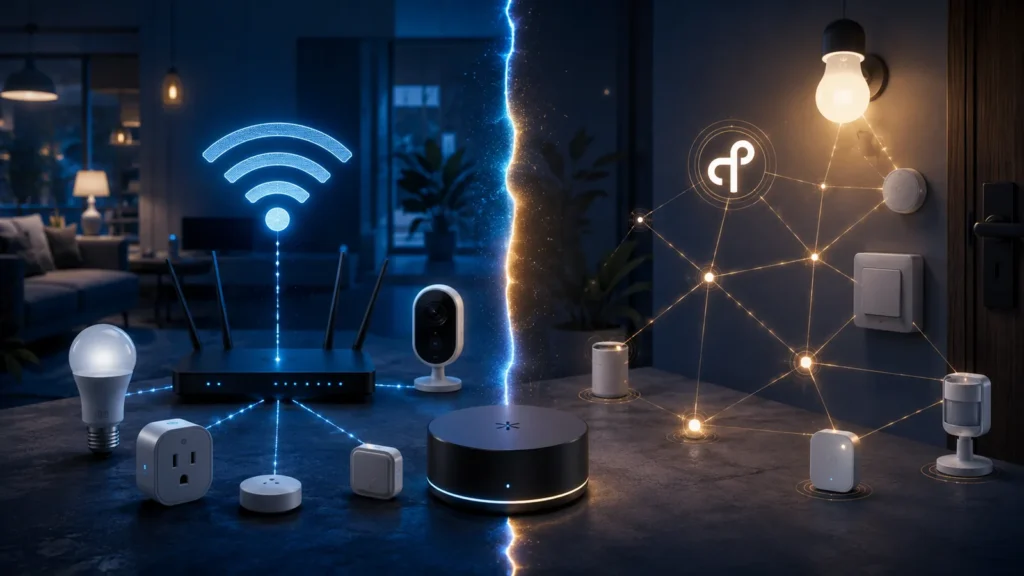
When two products both carry the Matter logo, they can still have very different networking requirements. One may join the home Wi-Fi network directly; another may join a Thread mesh. Understanding that difference helps you design the infrastructure before buying devices.
- Matter is the application layer; Wi-Fi and Thread are transports.
- Thread is optimized for low-power mesh IoT devices.
- Wi-Fi offers much more bandwidth and already exists in virtually every home.
- Matter-over-Thread devices need Thread infrastructure and a Border Router.
- Choose transport by device requirements, not by trying to standardize the whole home on one radio.
What stays the same: Matter
Whether a product uses Wi-Fi or Thread, Matter defines the compatible device behavior, commissioning model and ecosystem interoperability. The transport sits underneath that application layer.
This is why a Matter controller can interact with both device types even though their radio networks are different.
Matter over Wi-Fi
A Matter-over-Wi-Fi product joins the normal WLAN and communicates over IP. It does not require a Thread Border Router. This makes infrastructure straightforward because the network already exists, but large numbers of IoT devices still consume Wi-Fi airtime and depend on WLAN coverage.
Matter over Thread
A Matter-over-Thread product joins a Thread IPv6 mesh. Thread is based on IEEE 802.15.4 and targets low-power IoT connectivity. A Thread Border Router routes traffic between the Thread mesh and adjacent IP networks such as Ethernet/Wi-Fi LAN.
| Characteristic | Matter over Wi-Fi | Matter over Thread |
|---|---|---|
| Network | Home Wi-Fi | Thread mesh |
| Bandwidth | High | Low, designed for IoT control traffic |
| Battery suitability | Varies; typically less ideal | Excellent fit |
| Extra infrastructure | Normal Wi-Fi AP/router | Thread Border Router |
| Mesh routing | Depends on Wi-Fi topology | Native Thread mesh |
| Typical devices | Plugs, appliances, bridges, higher-bandwidth devices | Sensors, locks, controls |
Power consumption
Thread’s design is particularly attractive for devices that need to sleep for long periods and wake briefly to send small messages. Wi-Fi can be power-efficient in modern implementations, but Thread was built around low-power IoT from the start.
Bandwidth
A motion sensor does not need video-class throughput. A camera does. Thread deliberately trades bandwidth for low-power mesh behavior, while Wi-Fi is designed to carry much richer traffic. Choose accordingly.
Coverage and mesh behavior
Thread routing-capable devices can forward traffic within the mesh. Battery sleepy end devices generally conserve power rather than acting as the network backbone. Wi-Fi coverage depends on your router/access-point topology; a mesh Wi-Fi system is a separate concept from Thread mesh.
What a Thread Border Router changes
The Border Router is not a proprietary protocol translator. Thread already carries IPv6. The Border Router provides routing between Thread and the rest of the IP network. Some smart speakers, hubs and routers integrate this capability.
Does Wi-Fi need a hub?
Matter still needs a controller in the ecosystem, but a Matter-over-Wi-Fi accessory does not need a Thread Border Router. The controller may itself be a speaker, hub, phone/tablet or other supported platform component.
Which is better for sensors?
Thread is often the stronger architectural fit for battery sensors because of low power and mesh design. Zigbee remains another mature option in existing systems. If you are buying new Matter-native sensors, Thread is worth prioritizing when your ecosystem already has good Border Router coverage.
Which is better for smart plugs?
Both can work well. A mains-powered smart plug has no severe battery constraint, so Wi-Fi is perfectly reasonable. A Thread plug can also strengthen the Thread mesh if it acts as a routing device. Device quality and ecosystem support may matter more than the transport.
Which is better for cameras?
Wi-Fi or Ethernet. Cameras need far more bandwidth than Thread was designed to provide. Matter support for a device category does not imply every network transport is appropriate for that category.
What happens when the internet goes down?
Both Matter-over-Wi-Fi and Matter-over-Thread can support local IP communication when the local infrastructure remains available. However, apps, remote access, voice assistants and vendor-specific features may still depend on cloud services. “Matter” should not be read as a guarantee that every product feature is offline-capable.
Can you mix both?
Yes — and that is usually the sensible design. A home can use Ethernet for fixed infrastructure, Wi-Fi for high-bandwidth devices, Thread for low-power endpoints and even Zigbee through a bridge for established devices.
See Matter vs Thread for the protocol layers and our Matter + Thread build guide for a complete architecture.
Buying checklist
- Check the product label for “Matter over Wi-Fi” or “Matter over Thread.”
- For Thread, verify your ecosystem has a compatible Border Router.
- For Wi-Fi, confirm reliable coverage at the installation point.
- For battery devices, compare expected battery life and transport.
- Check vendor firmware/update policy regardless of protocol.