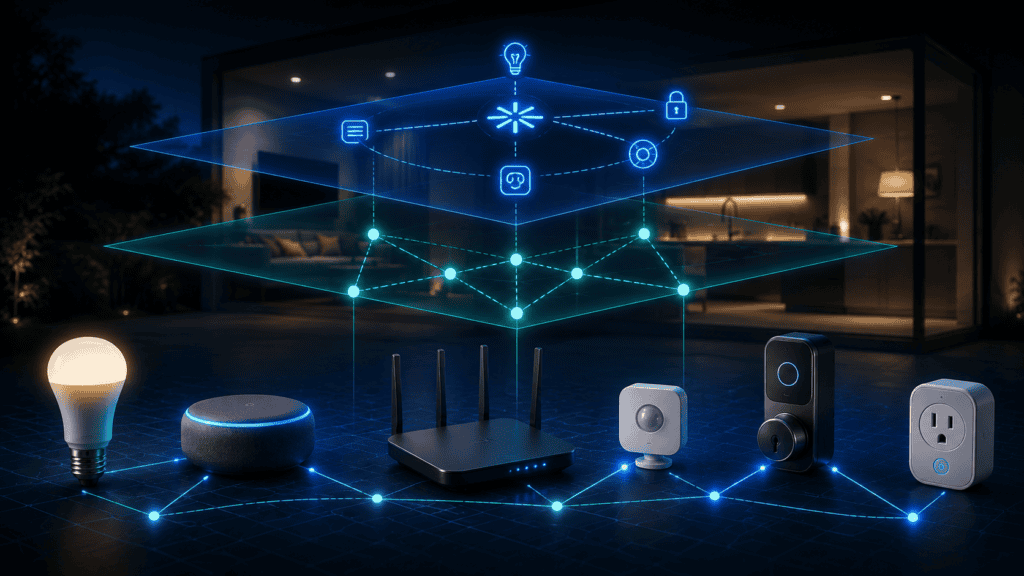
The easiest way to understand the relationship is to separate what devices say from how the packets travel. Matter is concerned with interoperable device behavior and control. Thread is one network transport that is particularly well suited to low-power smart-home devices.
- Matter is an application/interoperability standard.
- Thread is a low-power IPv6 mesh network.
- Matter can run over Thread, Wi-Fi and Ethernet.
- Matter-over-Thread devices need Thread infrastructure and a Thread Border Router to reach the wider IP network.
- Thread can support application protocols other than Matter.
A simple mental model
Think of Matter as a shared language and Thread as one road that can carry that language. A battery door sensor can speak Matter and use Thread as its radio network. A smart plug can speak Matter and use Wi-Fi instead. The Matter commands can still represent the same type of device behavior even though the transport differs.
What Matter is
Matter is an IP-based application-layer standard developed by the Connectivity Standards Alliance. It aims to make supported smart-home devices work more consistently across participating ecosystems by defining common data models, commissioning behavior and device interactions.
That does not mean every Matter product has identical features in every app. Ecosystems can still expose different interfaces and value-added functions. Matter’s role is to create a common interoperable foundation.
What Thread is
Thread is a secure, low-power IPv6 mesh networking protocol built on IEEE 802.15.4. Thread Group describes it as an IP-based mesh designed for IoT devices, with low energy use, self-healing behavior and no single required proprietary gateway translating the protocol into IP.
Mains-powered Thread devices can help route traffic through the mesh, while sleepy battery devices can conserve energy. The exact roles are determined by the Thread network rather than by every device operating identically.
Why Thread fits battery devices
Battery sensors, locks and controls need small packets, low standby power and reliable local connectivity more than they need multi-hundred-megabit throughput. Thread was designed around this class of device. Wi-Fi remains better suited to high-bandwidth products such as cameras and media devices.
What a Thread Border Router does
A Thread Border Router connects the Thread mesh to the rest of the IP network. It is not the same thing as a proprietary application bridge translating one smart-home protocol into another. Because Thread already carries IPv6, the Border Router provides routing between the Thread network and adjacent IP networks.
Border Router capability can be built into smart speakers, hubs, routers and other infrastructure. A home can also contain multiple Border Routers for resilience and coverage.
| Question | Matter | Thread |
|---|---|---|
| What layer? | Application / interoperability | Network / transport |
| What problem? | Common device behavior across ecosystems | Low-power IP mesh connectivity |
| Is it IP-based? | Yes | Yes, IPv6 |
| Can it work over Wi-Fi? | Yes | No — Thread is its own radio network |
| Can it be used for battery sensors? | Yes, often over Thread | Yes, a core use case |
| Needs a Border Router? | Only Matter-over-Thread devices do | For connection to adjacent IP networks |
Matter over Thread vs Matter over Wi-Fi
Both are Matter. The difference is the network beneath the application layer. Matter-over-Wi-Fi devices join the normal Wi-Fi network. Matter-over-Thread devices join a Thread mesh and reach the home LAN through a Border Router.
Thread is attractive for low-power devices and dense IoT deployments. Wi-Fi is familiar, high-bandwidth and already present in nearly every home. The best smart home usually uses the transport that fits each device instead of forcing one technology everywhere.
Do you need Thread to use Matter?
No. A Matter-over-Wi-Fi smart plug can work without Thread. A Matter controller still needs to be present in your ecosystem, but Thread infrastructure is only necessary for Matter-over-Thread products.
Do you need Matter to use Thread?
No. Thread is a networking technology and can carry other application layers. Matter is simply the application standard that has made Thread much more visible to consumers.
Why people confuse the terms
Many newer low-power Matter products use Thread, and platform vendors often advertise both at the same time. Product pages may list “Matter over Thread,” while smart speakers are advertised as both Matter controllers and Thread Border Routers. That makes the layers look like one feature even though they are separate.
What should you buy in 2026?
- For battery sensors and locks, Matter over Thread is often a strong fit.
- For cameras and other high-bandwidth devices, Wi-Fi/Ethernet remains more natural.
- If buying Thread devices, confirm your chosen ecosystem includes a compatible Thread Border Router.
- Do not replace a reliable Zigbee system only because Matter and Thread are newer.
How this affects a real smart-home design
A practical home might use Ethernet for fixed infrastructure, Wi-Fi for phones/cameras/speakers, Thread for battery sensors, and a Zigbee bridge for established devices. Matter can provide a common application layer across part of that system. The goal is reliability and interoperability, not protocol purity.
Our Matter + Thread smart-home guide shows how to plan the infrastructure in the right order. For the other common comparison, see Matter vs Zigbee.
How Thread networks form and heal
Thread devices organize themselves into roles within the mesh. Routing-capable devices can forward traffic, while sleepy end devices conserve power. The network can select new paths when topology changes, which is why Thread is described as self-healing. That does not mean every installation is automatically perfect — radio placement and the number of routing-capable devices still matter.
Thread Border Router vs Matter controller: common combinations
A single consumer product may perform both roles, which is convenient but creates terminology confusion. A smart speaker can be a Matter controller, a Thread Border Router, both, or neither depending on the exact model. Check specifications instead of assuming the product category determines the role.
Failure modes are different at each layer
| Symptom | Likely layer to inspect |
|---|---|
| Thread device has no network path | Thread mesh / Border Router |
| Device is reachable but not exposed correctly | Matter controller / application layer |
| Phone cannot control anything remotely | LAN/cloud/platform path |
| Only one ecosystem has the device | Multi-admin / commissioning state |
Why IP matters
Thread’s IPv6 foundation means the smart-home network can use standard IP routing concepts rather than requiring a proprietary translation step for every packet. Matter builds on this by defining the application behavior. The layering is one reason the two technologies complement each other so naturally.