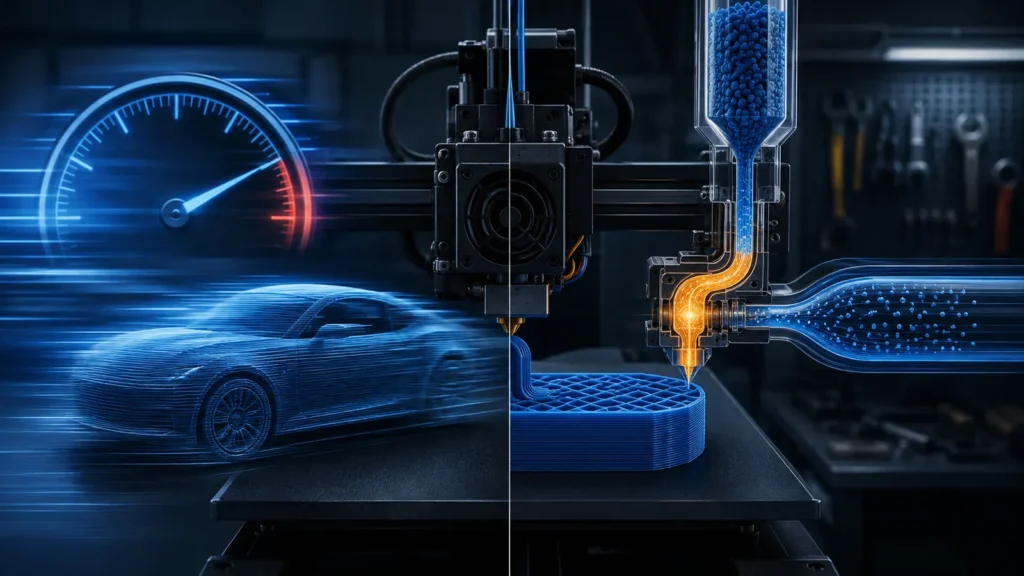
“How fast can this printer print?” sounds like a simple question, but one mm/s number tells only part of the story. A 300 mm/s travel move is very different from a 300 mm/s extrusion move using a wide line and thick layer. The hotend only cares about how much material it must melt per second.
- Print speed is measured in mm/s.
- Volumetric flow is measured in mm³/s.
- Flow depends on speed × line width × layer height.
- A larger nozzle or thicker layer raises flow demand dramatically.
- Hotend capacity, filament, temperature and cooling determine the practical limit.
The basic formula
A useful approximation is:
Volumetric flow = print speed × extrusion width × layer height
For example, a 0.45 mm line width at 0.20 mm layer height and 200 mm/s requires about 18 mm³/s of material flow.
| Speed | Line width | Layer height | Approx. flow |
|---|---|---|---|
| 100 mm/s | 0.45 mm | 0.20 mm | 9 mm³/s |
| 200 mm/s | 0.45 mm | 0.20 mm | 18 mm³/s |
| 200 mm/s | 0.60 mm | 0.30 mm | 36 mm³/s |
| 300 mm/s | 0.45 mm | 0.20 mm | 27 mm³/s |
Why mm/s alone can be misleading
Manufacturers often advertise high movement speeds because the number is easy to understand. But a printer may reach that speed only on travel moves or small sections where flow demand is low. Thick infill, wide extrusion and large layers can hit the hotend’s melting limit much earlier.
What happens when you exceed the hotend limit
- Under-extrusion
- Weak layer bonding
- Thin or rough walls
- Inconsistent extrusion width
- Clicking/skipping at the extruder
- Loss of dimensional accuracy
The failure may look like a mechanical extrusion problem even though the root cause is simply that the requested material flow is too high.
Nozzle size changes everything
A 0.6 mm nozzle can move more material per line than a 0.4 mm nozzle. That makes it excellent for reducing print time at moderate movement speeds, but it also asks more from the hotend. A printer that handles 250 mm/s with a 0.4 mm nozzle may not sustain the same movement speed at a thick 0.6 mm profile.
Layer height is equally important
Doubling layer height roughly doubles the volume extruded per millimeter of travel. This is why “same speed, bigger layer” can create under-extrusion even when the machine seemed stable before.
Filament type affects sustainable flow
PLA typically melts and flows more easily than many engineering materials. PETG, filled materials and high-temperature polymers can require different temperatures and may have a lower practical flow limit in the same hotend.
Temperature can increase flow — within reason
Increasing nozzle temperature can help the polymer melt faster and reduce viscosity. But too much heat can increase stringing, degrade surface quality or damage temperature-sensitive materials. Use the filament manufacturer’s range as the starting point and test deliberately.
Acceleration and geometry can hide the limit
A slicer may request 300 mm/s, but short features may never reach that speed because the printer is constantly accelerating and decelerating. Long straight infill lines are more likely to expose the actual hotend flow ceiling.
How slicers use maximum volumetric flow
Modern slicers can cap extrusion speed based on a maximum volumetric flow value. That allows the slicer to reduce movement speed automatically when a line width/layer combination would exceed the material profile’s flow limit.
When you should tune volumetric flow
- After changing hotend or nozzle type
- When switching to a very different filament family
- When building a high-speed profile
- If high-speed sections show under-extrusion
- When moving from 0.4 to 0.6 mm nozzles or thicker layers
Do not chase the absolute maximum
A profile that barely survives a flow test can be unreliable in a real print with changing geometry, cooling conditions and material variation. Leave some margin rather than setting the slicer exactly at the failure threshold.
Practical example
Suppose your hotend is reliable at 20 mm³/s. With a 0.45 mm extrusion width and 0.20 mm layer, the approximate speed ceiling is around 222 mm/s. Increase layer height to 0.28 mm and the same flow limit drops the movement speed ceiling to around 159 mm/s.