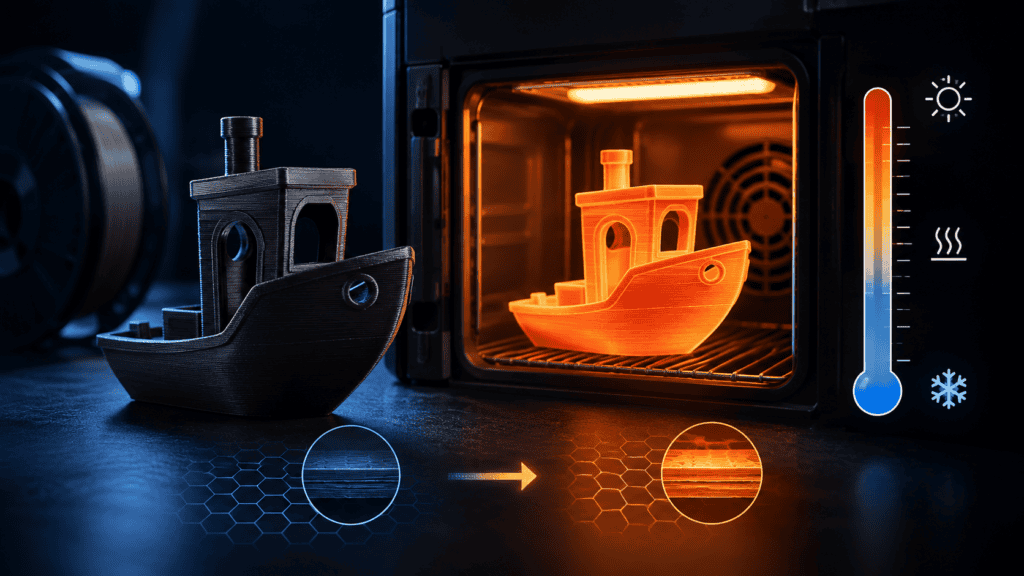
“High-temperature PLA” sounds contradictory because standard PLA is known for softening relatively early. The important detail is formulation and post-processing. HT PLA is not one standardized polymer; it is a marketing/material category covering modified PLA blends designed for improved thermal performance.
- HT PLA is still PLA-based but usually modified for better crystallization or thermal behavior.
- Many grades require annealing to reach advertised heat resistance.
- Annealing can change dimensions.
- Printability is often easier than ABS/ASA or engineering nylons.
- For critical hot parts, use the manufacturer’s post-anneal datasheet rather than generic PLA assumptions.
Why normal PLA softens relatively early
Standard PLA has a glass-transition region low enough that a part can deform in a hot car, near electronics or under mechanical load at elevated temperature. This is one of PLA’s main limitations for functional use.
How HT PLA improves heat performance
Many HT PLA formulations are designed to crystallize more effectively during annealing. Increased crystallinity can raise the temperature at which the part retains useful stiffness.
Annealing is often part of the material system
Annealing means heating the printed part below its melting point for a controlled period. The process allows molecular structure to reorganize and can increase crystallinity.
Dimensional change during annealing
Annealing can shrink the part in one direction and expand it in another depending on print orientation, geometry and material. Functional parts may need compensation in CAD or slicer scaling.
How much heat resistance can you expect?
There is no universal number. Different formulations and test methods produce different HDT/Vicat values. Always read the specific datasheet and note whether the sample was annealed.
| Material | Print difficulty | Typical heat potential | Main caveat |
|---|---|---|---|
| Standard PLA | Easy | Low | Softens in hot environments |
| HT PLA | Easy to moderate | Higher after proper processing | Annealing/dimensional change |
| PETG | Easy to moderate | Moderate | Can creep under heat/load |
| ASA | Moderate | Higher | Enclosure/fumes |
| PC / engineering PA | Difficult | High | Printer requirements |
Why choose HT PLA instead of ASA or PC?
HT PLA can be attractive when you want PLA-like printability but need more heat resistance after post-processing. It may warp less than ABS/ASA and can be easier on open printers.
When HT PLA is not the right choice
If the part is continuously exposed to high temperature, chemicals, UV or severe mechanical load, an engineering polymer designed for that environment may be more appropriate. HT PLA is not a universal replacement for PC, PA-CF or PPA-CF.
Typical use cases
- Jigs and fixtures exposed to moderate heat
- Electronics housings
- Functional prototypes
- Parts that need easy printing plus improved thermal margin
Printing HT PLA
Most formulations print similarly to PLA, but nozzle and bed temperatures can be higher. Cooling guidance also varies. Use the manufacturer profile as the starting point.
How to anneal safely
- Use the manufacturer’s temperature and time.
- Measure the oven/dryer temperature independently if accuracy matters.
- Support thin or delicate geometry if recommended.
- Measure the part before and after treatment.
- Do a small calibration coupon before annealing a critical component.
Does annealing make it stronger?
Annealing can change mechanical properties and heat resistance, but “stronger” depends on the test. Increased crystallinity may improve some properties while dimensional change or brittleness becomes a trade-off. Use the specific material datasheet.
Surface finish after annealing
Some HT PLA parts retain appearance well, while others can warp slightly or show texture changes. Thin walls and large flat parts are more vulnerable to distortion.
HT PLA vs PETG
PETG may be a simpler choice if you only need a moderate heat improvement and better toughness without post-processing. HT PLA becomes interesting when the annealed heat performance is the specific target.
HT PLA vs ASA
ASA offers better outdoor/UV performance and does not depend on post-print annealing for its core thermal behavior, but it needs better enclosure and ventilation management. The two materials solve different problems.