
I will show you how to easily build a DIY LiPo Battery Discharger using halogen light bulbs. This discharger is capable of handling 2S, 3S, 4S, 5S, and 6S LiPo batteries. A halogen bulb discharger is an effective method for discharging LiPo batteries, either for storage or disposal.

There are other methods of discharging LiPo batteries, find out more here: https://oscarliang.com/dispose-lipo-battery-safely/.
How to Use
Simply plug your battery into the light bulb discharger and place it in a fire-safe area.
If you are discharging for storage, monitor the battery voltage closely. When the voltage drops to around 3.85V per cell, unplug the battery. The cells may not be balanced and could require further balancing using a LiPo charger in storage mode.
Further Reading: how should LiPo batteries be handled properly: https://oscarliang.com/lipo-battery-guide/
If you are discharging for disposal, leave the battery plugged in until the light goes out, indicating that discharging has stopped. Note that halogen light bulbs have a cutoff voltage of around 1 to 2V, meaning they won’t completely discharge the battery. Confirm the final voltage using a multimeter set to voltage mode: https://oscarliang.com/multimeter-fpv/#How-to-Measure-DC-Voltage.
If there’s a little charge left, I simply connect it to a power resistor to bring the voltage to zero, which shouldn’t take long. Finally, finish it off by carefully shorting the positive and negative leads in the battery in a fire-safe place before disposing.
This method can completely discharge a fully charged 4S 1500mAh LiPo battery in less than an hour.
LiPo Discharger Circuit Diagram
I use 6 light bulbs in this discharger, along with an on-off toggle switch.
There are options for 12V/24V discharging modes:
- 12V for 2S/3S LiPo
- 24V for 4S and 6S
The maximum voltage of a 6S LiPo is 25.2V, which is higher than 24V, but it should be fine for short periods, especially since you are often discharging half-empty batteries.
The halogen bulbs I am using are rated at 20W, so at 12V, each will draw 1.67A of current. With 3 bulbs in parallel, the total current draw will be around 5A, theoretically draining a 3S 2000mAh battery in just 24 minutes. However, as the voltage of the battery drops, the current draw decreases, and the discharge will take longer than 24 minutes.

I’ve kept the design as simple as possible, all the parts are available on Amazon or AliExpress. The total cost should be less than $10.
12V 20W Halogen Bulbs x 6:
3-pin PCB screw terminals x 4:
Prototyping board x 1:
Two long electrical wires suitable for the discharging current (my max discharging current is 10A, so 20AWG should be enough. Check out this Wire AWG Chart for the suitable wire gauge):
Male & female XT60 connectors x 1:
Male 3.5mm bullet connector x 1 (can be inserted into XT60 female connector):
On-off toggle switch x 1 (optional):


Building the LiPo Discharger
PCB Screw Terminals
You can solder the light bulbs directly to the PCB, but I prefer using screw PCB terminals for easier bulb replacement when needed (although I did not have to replace a single bulb in the 6 years I’d been using this discharger). They also potentially allow you to connect different types of electrical loads, such as high power resistors, making it a more flexible device.

Ensure you add plenty of solder to handle the high current.

12V/24V Discharging Mode Switch
The light bulbs are rated for 12V, so for discharging a 4S battery or higher, you need to put these bulbs in series, effectively doubling the voltage rating to 24V.
This is why I am using a 3.5mm bullet connector, acting as the “mode switch”. You can use it to connect either just the first array of bulbs for discharging 2S-3S LiPo (3 bulbs connected in series) , or to two arrays of bulbs connected in parallel for discharging 6S LiPo (3 bulbs per array, 6 bulbs in total).

On-Off Switch and Discharge Cables
The on-off switch is optional, as you can turn off the discharger by simply unplugging the battery (or the bullet connector). However, a toggle switch can be more convenient and safer, allowing for quick shutdown during an emergency.
I use extra long electrical wires to keep the battery as far from the light bulbs as possible during discharging in case of a fire.


Future Upgrades
These bulbs can get very warm! I’m considering adding a fan on top to aid in heat dissipation. A small fan typically requires 5V, which would require a step-down voltage regulator that gets power from the battery being discharged.
I also plan to apply liquid electrical tape over all soldered joints and connections to prevent short circuits.
Testing
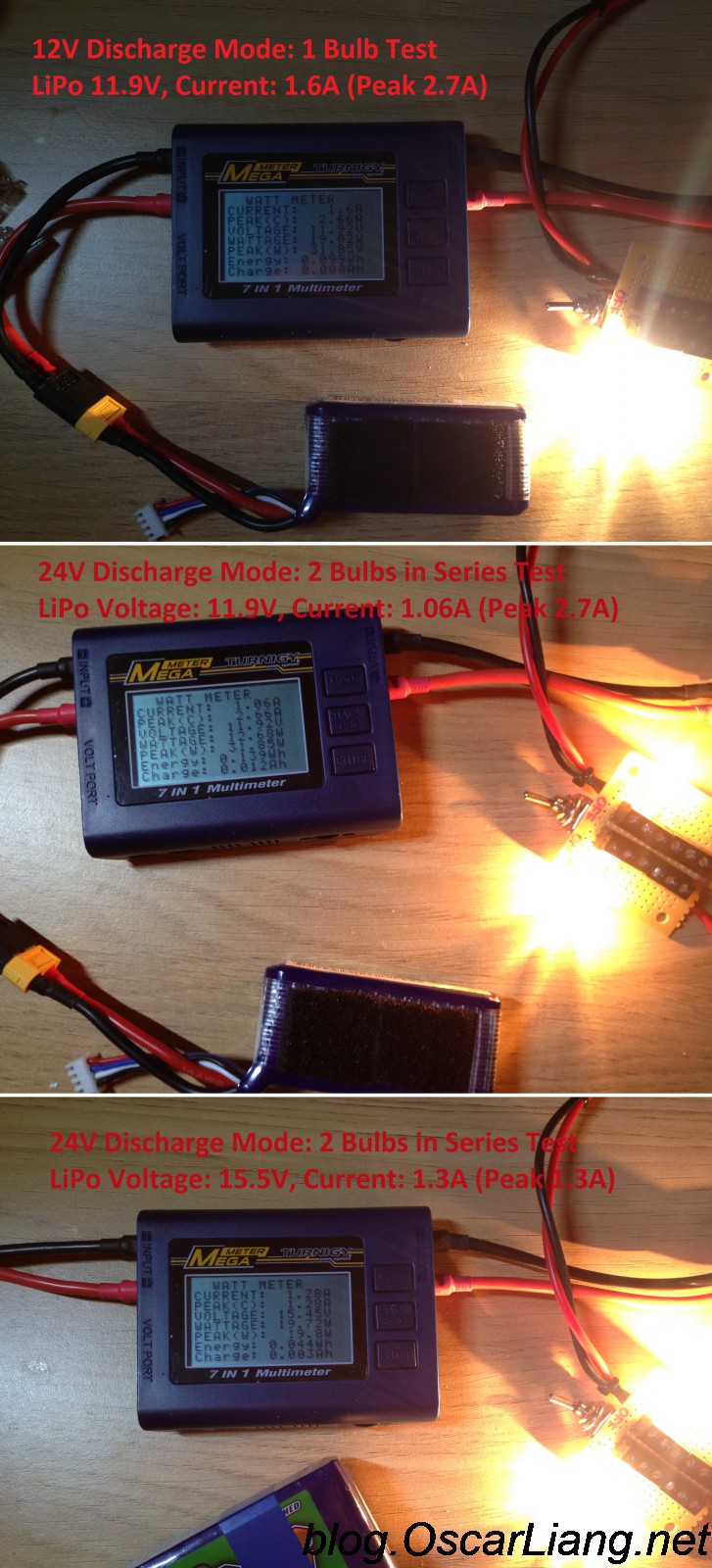
I tested the unit with just one bulb connected.
Upon turning on the light bulbs, I observed an initial current surge of 2.6A, which quickly stabilized at 1.6A. If I reconnect the bulb quickly, the surge doesn’t seem to occur again, which is an interesting observation, let me know in the comments in you know why.
These bulbs are rated at 20W. With a battery at 11.9V, the actual power draw is 19W, which is slightly lower than expected but ok.
In the 24V discharging mode (using two arrays of bulbs in parallel), the power consumption drops by nearly half as expected. Therefore, once you’ve partially discharged your 4S or 6S battery below 12V, it’s advisable to switch to the 12V discharge mode for more efficient discharging.
Edit History
- Oct 2015 – Article Created
- Jan 2018 – Updated article with a list of build components
- Jan 2024 – Updated instructions and product links