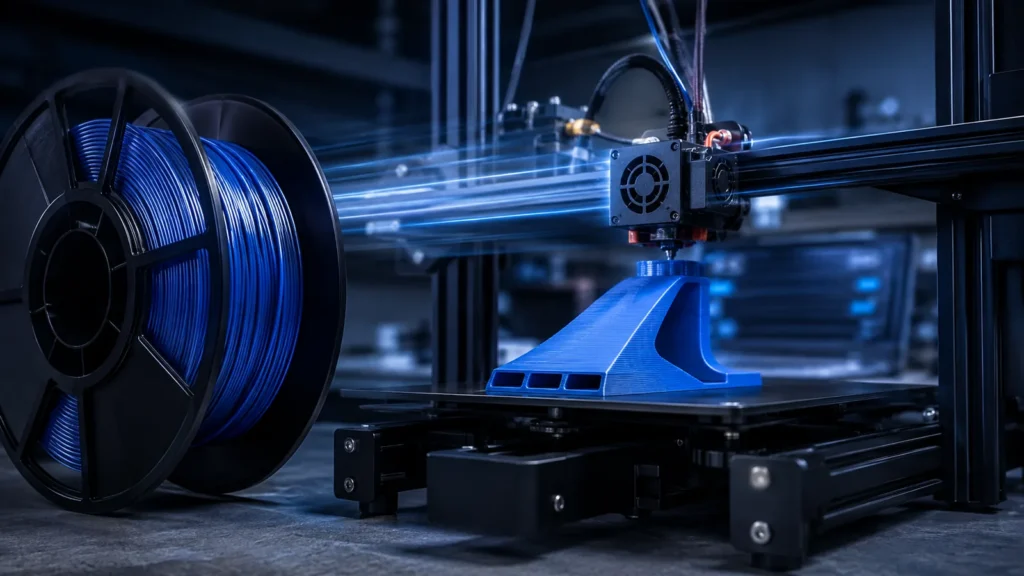
“High-speed filament” has become a common label on PLA, PETG and other materials, especially as modern CoreXY printers push much higher acceleration and flow rates. But the name can be misleading if it is interpreted as a guarantee that any printer can simply double its speed.
What high-speed filament is trying to improve
At higher print speeds, the extruder must push more plastic through the hotend every second. If the material does not absorb enough heat before leaving the nozzle, extrusion becomes inconsistent and under-extrusion appears even though the motion system is capable of moving faster.
Manufacturers can modify a polymer blend with additives or processing aids to improve melt flow, reduce viscosity in the printing window, or make the material tolerate a higher extrusion rate without losing surface quality.
Speed in mm/s is not the real limit
Movement speed alone is a poor way to compare filament capability. The more useful quantity is volumetric flow, measured in cubic millimeters per second.
A printer running 200 mm/s with a 0.2 mm layer height and narrow line width may be demanding less plastic than a printer running 120 mm/s with a 0.3 mm layer height and a 0.6 mm nozzle.
For the deeper explanation, see Print Speed vs Volumetric Flow and our OrcaSlicer maximum volumetric flow guide.
How high-speed PLA differs from ordinary PLA
There is no universal recipe. One manufacturer’s “Rapid PLA” may use a modified resin system, another may rely on processing additives, and another may simply recommend a wider temperature range.
Typical goals include:
- faster melting;
- stable extrusion at high flow;
- lower sensitivity to pressure changes;
- good layer bonding despite shorter heating time;
- surface quality that remains acceptable at high throughput.
Can ordinary filament print fast?
Absolutely. Many standard PLA and PETG filaments can reach surprisingly high flow rates when the hotend is capable and temperature is tuned correctly. A “high-speed” label only matters if the material actually maintains useful print quality and layer adhesion at higher throughput.
Why temperature often needs to increase
At higher material flow, each segment of filament spends less time in the hotend. Raising nozzle temperature can increase heat transfer and reduce melt viscosity. This is why high-speed profiles often use temperatures that look high compared with traditional slow profiles.
Do not increase temperature blindly. Too much heat can increase stringing, reduce overhang quality, darken some materials or create excessive gloss.
Cooling still matters
A material can melt fast and still fail at high speed if the printed layer cannot cool quickly enough. PLA bridges and overhangs in particular depend on sufficient part cooling. Larger parts can tolerate higher continuous speeds than tiny parts where minimum layer time becomes dominant.
High-speed PETG is more demanding
PETG naturally tends to string and remain sticky at the nozzle. Faster-flow PETG blends can help, but a high-speed PETG profile still needs careful temperature, cooling and pressure tuning.
Do you need high-speed filament?
| Use case | High-speed filament value |
|---|---|
| Older bed slinger at modest speeds | Usually small |
| Modern CoreXY printer | Potentially useful |
| Large production parts | Often useful |
| Miniatures / slow detail prints | Usually irrelevant |
| Flow-limited hotend | Helpful only within hotend limits |
How to test whether it is really faster
Use the same printer, nozzle and part-cooling setup, then compare maximum volumetric flow and final part quality. Do not judge only by the maximum speed printed on the spool box.
If a filament supports a meaningfully higher stable volumetric flow without under-extrusion or poor layer bonding, the high-speed formulation is doing something useful.
Bottom line
High-speed filament can be real, but it is not magic. Its job is to make high material throughput easier. Your printer still needs enough hotend power, suitable temperatures, cooling and calibration to exploit it.