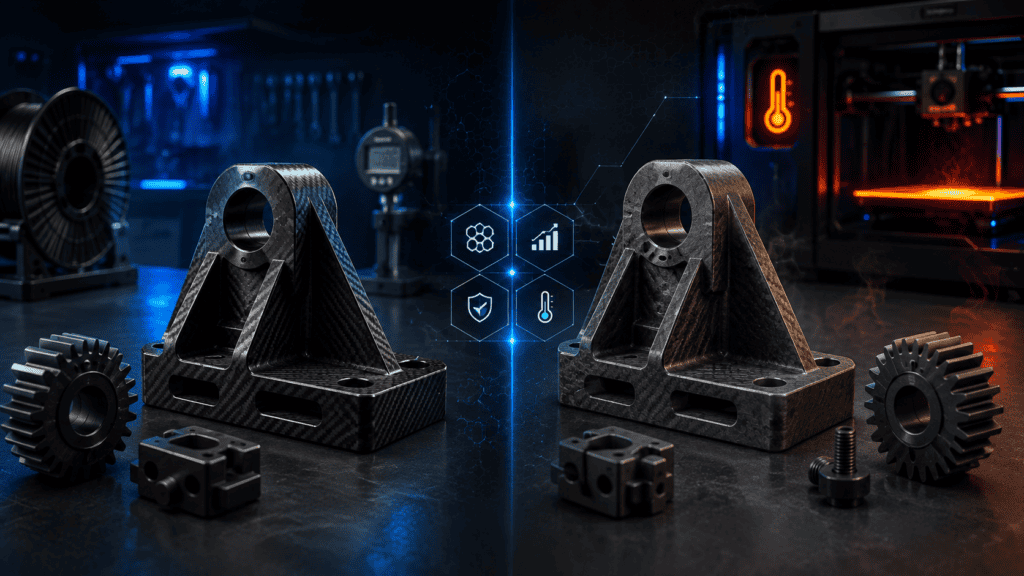
The important difference is the polymer matrix, not the carbon fiber itself. Carbon fiber improves stiffness and can reduce shrinkage in both families, but PA6-CF, PA12-CF and PPA-CF can behave very differently in heat, moisture and printing.
- “PA-CF” is not one material; always identify the base nylon.
- PPA is a semi-aromatic high-performance polyamide family.
- PPA-CF generally pushes further into high-temperature engineering use.
- Both families are abrasive and need wear-resistant nozzles.
- Drying, storage and chamber control remain important.
PA-CF can mean several different base polymers
A PA-CF spool may be based on PA6, PA12, PA612 or a proprietary blend. PA6 typically offers strong mechanical performance but absorbs more moisture. PA12 generally absorbs less moisture and can be easier to keep dimensionally stable. The exact formulation matters more than the generic PA-CF label.
What makes PPA different?
Polyphthalamide uses a more aromatic polymer structure than conventional aliphatic nylons. In engineering applications, that chemistry is used to improve thermal and dimensional performance. In filament, manufacturers often combine PPA with chopped carbon fiber for additional stiffness and reduced warpage.
| Property | Typical PA-CF | Typical PPA-CF |
|---|---|---|
| Heat performance | Moderate to high, grade-dependent | Generally higher |
| Moisture uptake | Can be high, especially PA6-based | Often lower than common PA6-CF |
| Stiffness | High | Often very high |
| Nozzle temperature | High | Very high |
| Enclosure/chamber | Helpful to important | Often essential |
| Cost | High | Usually higher |
Heat resistance: the biggest reason to move up
PPA-CF is typically selected when a conventional PA-CF part does not provide enough thermal margin. This can matter for fixtures around motors, electronics, machinery or automotive environments.
Always compare actual heat-deflection data under the same test conditions. A material name alone does not define service temperature.
Moisture sensitivity
All polyamides deserve moisture management. PPA formulations often absorb less moisture than PA6-based materials, but that does not make them “dry-box optional.” Moist filament can still cause rough extrusion, stringing and property loss.
Print temperature and hotend requirements
PPA-CF can require nozzle temperatures beyond the safe range of PTFE-lined hotends. Use an all-metal/higher-temperature hotend rated for the filament manufacturer’s specification. The bed and chamber requirements can also be substantially higher.
Chamber temperature and layer bonding
High-performance polymers often benefit from a warm, stable chamber because the printed layer should not cool too aggressively before the next layer is deposited. Poor thermal control can cause warping or weak interlayer bonding even when the nozzle temperature is technically high enough.
Carbon fiber does not eliminate anisotropy
Chopped fibers generally align with extrusion flow, so printed parts remain anisotropic. Stiffness may improve strongly in the XY direction while Z-direction strength still depends heavily on layer bonding.
Nozzle and extruder wear
Both PA-CF and PPA-CF are abrasive. Use hardened steel, tungsten carbide or another composite-capable nozzle. Hardened drive gears are also advisable for frequent use.
0.4 or 0.6 mm nozzle?
Many composite filaments work with 0.4 mm nozzles, but 0.6 mm offers more clearance for chopped fibers and can improve reliability at higher flow. Follow the filament manufacturer’s recommendation.
When ordinary PA-CF is the better choice
- Workshop jigs and fixtures
- Strong mechanical parts at moderate temperatures
- Applications where toughness matters more than extreme heat
- When printer capability is below PPA processing requirements
- When lower material cost matters
When PPA-CF is justified
- Higher continuous thermal load
- More demanding dimensional stability
- High-stiffness engineering fixtures
- Applications sensitive to moisture-driven dimensional change
- Printers already equipped for high-temperature composites
Datasheets matter more than family names
Compare tensile modulus, impact strength, HDT, moisture conditioning, fiber content and print requirements. One premium PA-CF can overlap with another vendor’s PPA-CF, so category labels should guide the search, not end it.
Annealing and post-processing
Some manufacturers specify annealing to reach peak thermal properties. That can change dimensions, so dimensional compensation may be necessary. Follow the exact vendor process rather than applying a generic nylon annealing recipe.
A practical decision rule
- If PA-CF already meets heat and stiffness requirements, stay with it.
- If service temperature is the limiting factor, compare PPA-CF datasheets.
- If the printer lacks chamber/hotend capability, upgrade hardware before buying the material.
- If moisture control is poor, solve storage/drying first.
For more context, see PPA-CF Explained and our abrasive-nozzle guide.