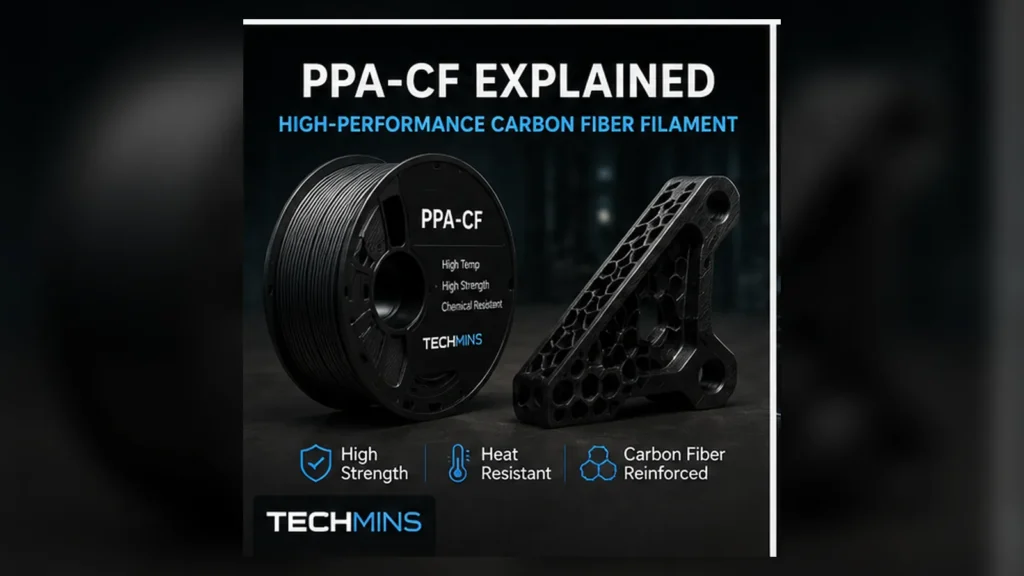
PPA-CF is a high-performance engineering filament that combines a PPA-class polyamide with chopped carbon fiber. It is designed for parts that need high stiffness, dimensional stability and strong thermal performance.
What does PPA mean?
PPA stands for polyphthalamide, a family of high-performance semi-aromatic polyamides. Formulations vary significantly by manufacturer, so “PPA-CF” is not one universal material specification. Always use the technical data sheet for the exact filament.
Why carbon fiber?
Short carbon fibers can increase stiffness and improve dimensional behavior. They also make the material abrasive, so nozzle wear becomes a real concern.
PPA-CF vs PA6-CF
PA6-CF is already a capable engineering material, but PA6 is strongly affected by moisture. PPA-based composites are often selected when greater stiffness retention, temperature capability and improved moisture behavior are required.
For a direct comparison, see PA-CF vs PPA-CF.
PPA-CF is still moisture-sensitive while printing
Reduced moisture uptake compared with some nylons does not mean the spool can be printed wet. Moisture in the melt can cause stringing, oozing, rough extrusion and inconsistent properties. Bambu’s PPA/PPS guidance specifically warns that PPA-CF is very sensitive to humidity during printing.
Use our filament drying guide before attempting expensive engineering polymers.
Typical hardware requirements
- high-temperature hotend;
- hardened or similarly wear-resistant nozzle;
- heated bed appropriate to the material;
- enclosure and preferably a warm chamber for demanding geometry;
- dry filament storage and ideally a dry feed path.
Some PPA-CF formulations call for nozzle temperatures near 300–340 °C. Do not assume a printer that handles ordinary PA-CF can automatically handle PPA-CF.
Do you need a 0.6 mm nozzle?
A larger opening can reduce clogging risk with fiber-filled materials. A 0.4 mm hardened nozzle may work for some products, but manufacturer guidance should take priority. See 0.4 vs 0.6 mm nozzle and our abrasive-filament nozzle guide.
What PPA-CF is good at
- stiff functional parts;
- high-temperature service;
- dimensionally stable fixtures and brackets;
- engineering parts where creep and softening matter.
Where it is a poor choice
PPA-CF is usually unnecessary for decorative prints, ordinary indoor brackets and prototypes that PETG, ASA or a cheaper nylon can handle. Using a premium material without a requirement for its properties simply increases cost and process difficulty.
PPA-CF vs PET-CF vs PPS-CF
PET-CF can be easier to process and dimensionally stable. PPA-CF offers a strong balance of stiffness and thermal performance. PPS-CF can go further in heat and chemical resistance, but its processing requirements are also more demanding.
Before printing PPA-CF
- confirm hotend temperature capability;
- fit an abrasion-resistant nozzle;
- dry according to the manufacturer;
- keep the spool dry during printing;
- calibrate flow;
- check whether annealing is recommended.
If you are unsure whether this material is appropriate, start with the Techmins Filament Selector.
Bottom line
PPA-CF is a genuine engineering material. Its value lies in the combination of stiffness, temperature performance and dimensional stability — not simply the carbon-fiber appearance. For the right application it is excellent; for ordinary prints, simpler materials remain easier and cheaper.