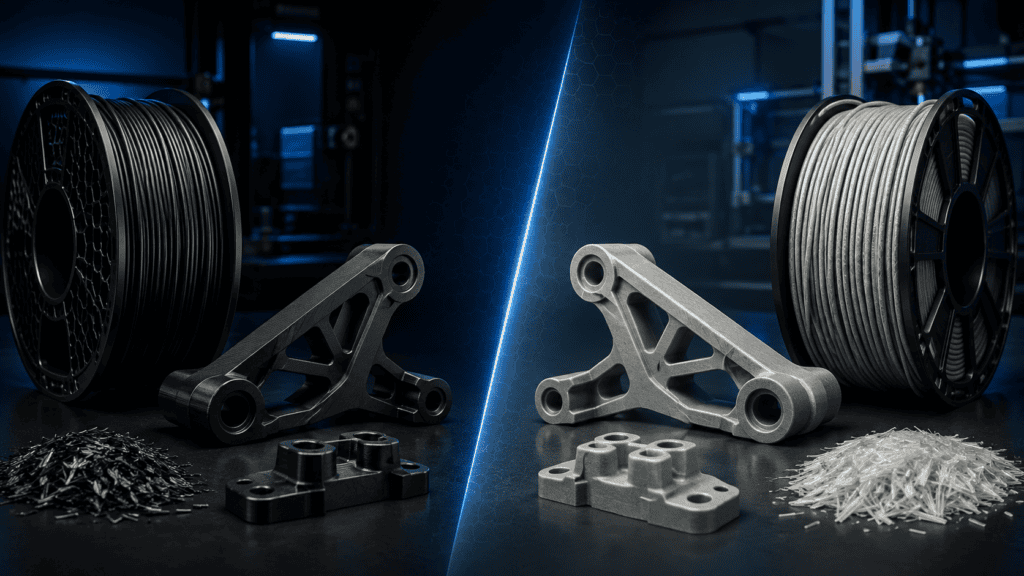
Reinforced PETG is attractive because it remains easier to print than many high-temperature engineering polymers while improving rigidity and dimensional behavior. But adding chopped fiber changes more than just strength: it affects impact behavior, surface finish, nozzle wear and interlayer performance.
- Carbon fiber generally creates a stiffer, dark matte part.
- Glass fiber can offer a different stiffness/toughness balance and broader colors.
- Both are abrasive and need a hardened nozzle.
- Both can be less ductile than plain PETG.
- Always compare manufacturer datasheets and fiber loading.
What chopped fibers change
Short fibers reinforce the polymer matrix and restrict shrinkage. This can improve stiffness, reduce warping and make dimensions more stable. At the same time, the fibers interrupt the continuous polymer matrix and can reduce elongation before break.
PETG-CF: typical behavior
PETG-CF is commonly chosen for rigid brackets, fixtures and housings. Carbon fibers usually produce a matte, technical-looking surface that hides layer lines well. The part often feels significantly stiffer than plain PETG.
PETG-GF: typical behavior
Glass-fiber-filled PETG can also improve stiffness and dimensional stability while allowing different color/appearance options. Depending on formulation, the toughness balance may differ from a carbon-filled version.
| Characteristic | PETG-CF | PETG-GF |
|---|---|---|
| Stiffness | Usually high | High, formulation-dependent |
| Surface | Dark, matte, technical | Textured / potentially lighter colors |
| Dimensional stability | Usually improved | Usually improved |
| Impact behavior | Can be more brittle than plain PETG | Depends strongly on formulation |
| Abrasive | Yes | Yes |
| Nozzle | Hardened recommended | Hardened recommended |
Are they stronger than ordinary PETG?
That depends on how you load the part. Fiber reinforcement typically improves stiffness and sometimes tensile properties, but plain PETG can stretch more before failure. For snap fits or impact-prone parts, extra stiffness can be a disadvantage.
Layer adhesion still matters
A reinforced filament can be very stiff in XY and still fail between layers if printed too cold or with excessive cooling. The strongest material datasheet cannot compensate for poor layer bonding.
Moisture can still spoil the result
PETG absorbs moisture from air. Filled PETG can show stringing, rough texture and inconsistent extrusion when damp. Dry the spool before trying to tune away symptoms with retraction.
Nozzle wear
Both carbon and glass fibers wear brass nozzles. A hardened steel nozzle is the practical baseline; premium wear-resistant nozzles can improve thermal behavior and lifespan.
0.4 vs 0.6 mm nozzle
A 0.6 mm nozzle provides more clearance for chopped fibers and is often a reliable choice. Some modern composite filaments are specifically formulated for 0.4 mm nozzles, so check the maker’s recommendation.
Flow and temperature
Fiber loading changes melt behavior. Do not assume the same temperature or maximum volumetric flow as plain PETG. Start from the manufacturer profile and recalibrate if you print fast.
When PETG-CF is a strong choice
- Rigid workshop fixtures
- Technical housings
- Parts where matte appearance matters
- Dimensional stability over flexibility
When PETG-GF can be better
- You need reinforced PETG in a lighter/non-carbon appearance
- The specific GF formulation offers a better impact balance
- Color options matter
- Cost or availability favors the GF grade
Heat resistance is still PETG-limited
Reinforcement can improve dimensional stability, but the PETG matrix still defines much of the thermal ceiling. For sustained high heat, ASA, PC, PA-CF or PPA-CF may be more appropriate.
Surface finish and post-processing
Carbon-filled surfaces are often naturally matte and hide print artifacts. Glass-filled surfaces can have a visibly textured appearance. Sanding either material can expose fibers, so use respiratory protection and avoid creating airborne composite dust unnecessarily.
Compare the datasheet, not only the label
Two PETG-CF products with different carbon loading can perform farther apart than a PETG-CF and PETG-GF from the same manufacturer. Compare modulus, tensile strength, elongation, HDT and recommended processing settings.
A practical selection checklist
- Do you prioritize stiffness or impact tolerance?
- Does surface color/finish matter?
- Can your printer use a hardened nozzle?
- Will the part see sustained heat?
- Does the vendor publish mechanical data?
- Can you keep the filament dry?
See Carbon Fiber vs Glass Fiber Filament for the broader reinforcement comparison and the hardened nozzle guide for hardware requirements.