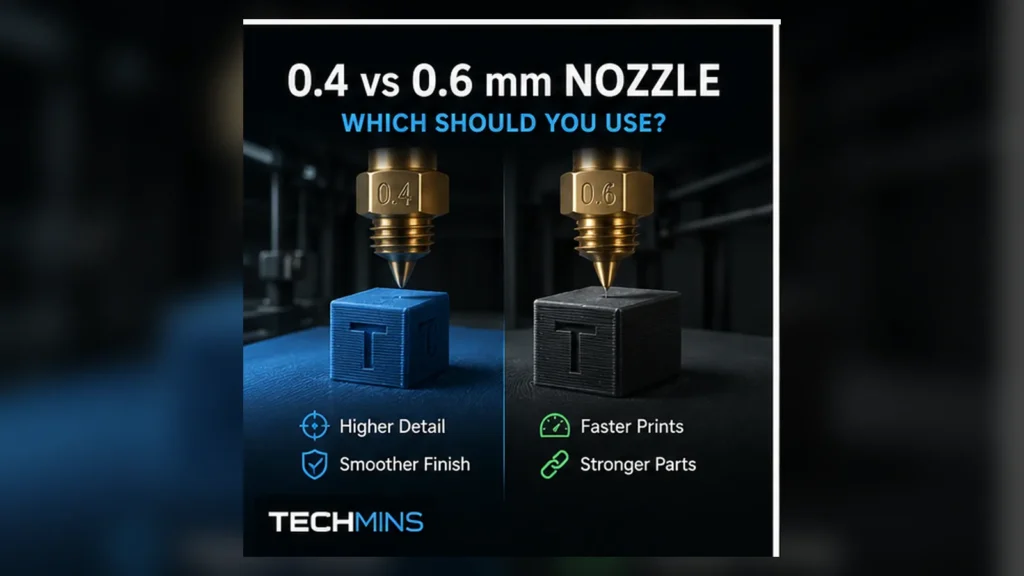
The 0.4 mm nozzle became the default on consumer 3D printers because it balances detail, speed and reliability. But for many functional parts, a 0.6 mm nozzle can be the better everyday tool.
What nozzle diameter changes
Nozzle diameter influences extrusion width, practical layer-height range, minimum feature size, flow demand and how efficiently walls can be constructed. When changing nozzle size, the slicer must use the correct nozzle profile.
| Characteristic | 0.4 mm | 0.6 mm |
|---|---|---|
| Fine detail | Better | Good |
| Large functional parts | Good | Excellent |
| Potential print-time reduction | Baseline | Often significant |
| CF/GF reliability | Material-dependent | Generally more forgiving |
Why 0.6 mm can be faster
A larger nozzle can lay down wider extrusion lines, allowing fewer toolpaths to build the same wall thickness. On suitable geometry, that can cut print time substantially.
However, the hotend still needs to melt the requested material. The real ceiling is often volumetric flow, not movement speed. See our OrcaSlicer maximum volumetric flow guide.
How much detail do you lose?
The difference depends on the model. A 0.4 mm nozzle is better for tiny text, miniature details, small holes and thin features. On enclosures, brackets, helmets, organizers and workshop parts, the visible difference can be surprisingly small.
Is 0.6 mm stronger?
The polymer itself does not become stronger. What changes is how the wall is built. Wider lines can create thick walls with fewer passes. Real strength still depends on material, orientation, temperature, wall thickness, infill and geometry.
Carbon- and glass-fiber filaments
Filled filaments are abrasive and may contain particles or fibers that make extrusion more demanding. A larger nozzle opening generally provides more clearance. You still need suitable wear resistance; read our hardened-nozzle guide.
Choose 0.4 mm when…
- fine detail matters;
- you print miniatures or small mechanical features;
- you want the broadest ready-made profile support;
- you frequently switch between very different model types.
Choose 0.6 mm when…
- you print large functional components;
- wall-building time dominates the print;
- you print helmets, enclosures or fixtures;
- you frequently use CF/GF-filled materials.
Recalibration after the swap
Verify nozzle diameter, extrusion widths, layer-height range, maximum volumetric flow and temperature. Depending on the printer, pressure advance may also need checking. If you are creating a new material profile, use our filament-profile tuning guide.
Bottom line
0.4 mm remains the safest universal choice; 0.6 mm is often better for practical FDM parts. It can reduce toolpaths and handle filled materials more comfortably without a dramatic quality loss on normal functional geometry.